↳
In-reply-to
»
We've barreled past the microblog line and flew straight over the e-mail chain line. This is just social blogging.
⤋ Read More
@mckinley@twtxt.net Haha, while composing I was wondering two or three times whether I should throw my thoughts in an HTML page instead. But out of utter laziness I discarded that idea. ¯_(ツ)_/¯
↳
In-reply-to
»
I did a take home software engineering test for a company recently, unfortunately I was really sick (have finally recovered) at the time 😢 I was also at the same time interviewing for an SRE position (as well as Software Engineering).
⤋ Read More
@prologic@twtxt.net Error handling especially in Go is very tricky I think. Even though the idea is simple, it’s fairly hard to actually implement and use in a meaningful way in my opinion. All this error wrapping or the lack of it and checking whether some specific error occurred is a mess. errors.As(…) just doesn’t feel natural. errors.Is(…) only just. I mainly avoided it. Yesterday evening I actually researched a bit about that and found this article on errors with Go 1.13. It shed a little bit of light, but I still have a long way to go, I reckon.
We tried several things but haven’t found the holy grail. Currently, we have a mix of different styles, but nothing feels really right. And having plenty of different approaches also doesn’t help, that’s right. I agree, error messages often end up getting wrapped way too much with useless information. We haven’t found a solution yet. We just noticed that it kind of depends on the exact circumstances, sometimes the caller should add more information, sometimes it’s better if the callee already includes what it was supposed to do.
To experiment and get a feel for yesterday’s research results I tried myself on the combined log parser and how to signal three different errors. I’m not happy with it. Any feedback is highly appreciated. The idea is to let the caller check (not implemented yet) whether a specific error occurred. That means I have to define some dedicated errors upfront (ErrInvalidFormat, ErrInvalidStatusCode, ErrInvalidSentBytes) that can be used in the err == ErrInvalidFormat or probably more correct errors.Is(err, ErrInvalidFormat) check at the caller.
All three errors define separate error categories and are created using errors.New(…). But for the invalid status code and invalid sent bytes cases I want to include more detail, the actual invalid number that is. Since these errors are already predefined, I cannot add this dynamic information to them. So I would need to wrap them à la fmt.Errorf("invalid sent bytes '%s': %w", sentBytes, ErrInvalidSentBytes"). Yet, the ErrInvalidSentBytes is wrapped and can be asserted later on using errors.Is(err, ErrInvalidSentBytes), but the big problem is that the message is repeated. I don’t want that!
Having a Python and Java background, exception hierarchies are a well understood concept I’m trying to use here. While typing this long message it occurs to me that this is probably the issue here. Anyways, I thought, I just create a ParseError type, that can hold a custom message and some causing error (one of the three ErrInvalid* above). The custom message is then returned at Error() and the wrapped cause will be matched in Is(…). I then just return a ParseError{fmt.Sprintf("invalid sent bytes '%s'", sentBytes), ErrInvalidSentBytes}, but that looks super weird.
I probably need to scrap the “parent error” ParseError and make all three “suberrors” three dedicated error types implementing Error() string methods where I create a useful error messages. Then the caller probably could just errors.Is(err, InvalidSentBytesError{}). But creating an instance of the InvalidSentBytesError type only to check for such an error category just does feel wrong to me. However, it might be the way to do this. I don’t know. To be tried. Opinions, anyone? Implementing a whole new type is some effort, that I want to avoid.
Alternatively just one ParseError containing an error kind enumeration for InvalidFormat and friends could be used. Also seen that pattern before. But that would then require the much more verbose var parseError ParseError; if errors.As(err, &parseError) && parseError.Kind == InvalidSentBytes { … } or something like that. Far from elegant in my eyes.
↳
In-reply-to
»
The US put tornadocash on sanction list. Deleted github accounts and source. Since North Korea used it to launder stolen crypto.
And people are surprised that it happened? Github is and never have been a safe place to store code. Tor/i2p is much more safer places to host code. But I understand why people use github, I do so as well for public project, but I also selfhost my other things
⤋ Read More
@abucci@anthony.buc.ci perfect, thank you :)
↳
In-reply-to
»
Also later today I need to set up that startupscript for yarnd, tired of manually starting it when vps boots.
⤋ Read More
@prologic@twtxt.net I think I saw something on the wiki. Ill check again tonight.
↳
In-reply-to
»
Kids are in bed, dog is sleeping, Marlyn is watching Tv, and I'm on the computer trying to figure out what to do for the rest of the night. Last week of vacation now, so I get more and more interrested in doing things on the computer. Played around a bit with my Risc-v SBC today (Mangopi), it runs debian, got everything updated and all that, thinking about setting up a webserver on it. It has 512mb ram, so it should be fine to host some static website on it.
⤋ Read More
@prologic@twtxt.net golang seems to work on it, so Ill give a try on compiling yarn on it tonight. Would be fun if it works.
↳
In-reply-to
»
Kids are in bed, dog is sleeping, Marlyn is watching Tv, and I'm on the computer trying to figure out what to do for the rest of the night. Last week of vacation now, so I get more and more interrested in doing things on the computer. Played around a bit with my Risc-v SBC today (Mangopi), it runs debian, got everything updated and all that, thinking about setting up a webserver on it. It has 512mb ram, so it should be fine to host some static website on it.
⤋ Read More
@prologic@twtxt.net
https://mangopi.cc/mangopi_mqpro
Search for it on amazon.
↳
In-reply-to
»
We got a ride on a 106 year old steamboat today :)
⤋ Read More
@lyse@lyse.isobeef.org yup :)
↳
In-reply-to
»
@abucci I think so. IndieAuth is what I'm a big fan of. All Yarn pods are IndieAuth providers for example (if there are any concumsers out there, we have to work on a consumer ourselves...)
⤋ Read More
@prologic@twtxt.net can Yarn pods be consumers to other yarn pods?
↳
In-reply-to
»
@abucci I think so. IndieAuth is what I'm a big fan of. All Yarn pods are IndieAuth providers for example (if there are any concumsers out there, we have to work on a consumer ourselves...)
⤋ Read More
@prologic@twtxt.net can Yarn pods be consumers to other yarn pods?
↳
In-reply-to
»
Stumbled on WebID today. Besides being confusing, it doesn't work on the site I tinkered with and it seems to be mostly abandoned?
⤋ Read More
@abucci@anthony.buc.ci I think so. IndieAuth is what I’m a big fan of. All Yarn pods are IndieAuth providers for example (if there are any concumsers out there, we have to work on a consumer ourselves…)
↳
In-reply-to
»
Good morning everyone, how are you all doing today?
⤋ Read More
@prologic@twtxt.net thank you, I like them as well, getting closer to autumn now, my favourite time of year for landscape photography in the morning and late evening :)
↳
In-reply-to
»
If you see this - then please give a reply so I know it all worked :)
Good to be back by the way.
⤋ Read More
@prologic@twtxt.net feel free to do so :) I do not plan to have it open for registration though. I might buy a domain and run a public one later on. But for not the one I run was for me.
↳
In-reply-to
»
If you see this - then please give a reply so I know it all worked :)
Good to be back by the way.
⤋ Read More
@prologic@twtxt.net i see your reply has twtxt account for my name in it - that account got removed some time ago.
↳
In-reply-to
»
Good morning everyone, how are you all doing today?
⤋ Read More
@abucci@anthony.buc.ci thank you :) I’m taking some more over the weekend, I’ll share them as well :)
↳
In-reply-to
»
Good morning everyone, how are you all doing today?
⤋ Read More
@prologic@twtxt.net oh, what illness did you get?
↳
In-reply-to
»
If you see this - then please give a reply so I know it all worked :)
Good to be back by the way.
⤋ Read More
@prologic@twtxt.net I installed my own on my vps :)
↳
In-reply-to
»
Good morning everyone, how are you all doing today?
⤋ Read More
@abucci@anthony.buc.ci doing well, 12 in the afternoon here, just came home from a walk in the woods with our dog, really warm and sunny today.
Hi, I am playing with making an event sourcing database. Its super alpha but I thought I would share since others are talking about databases and such.
It’s super basic. Using tidwall/wal as the disk backing. The first use case I am playing with is an implementation of msgbus. I can post events to it and read them back in reverse order.
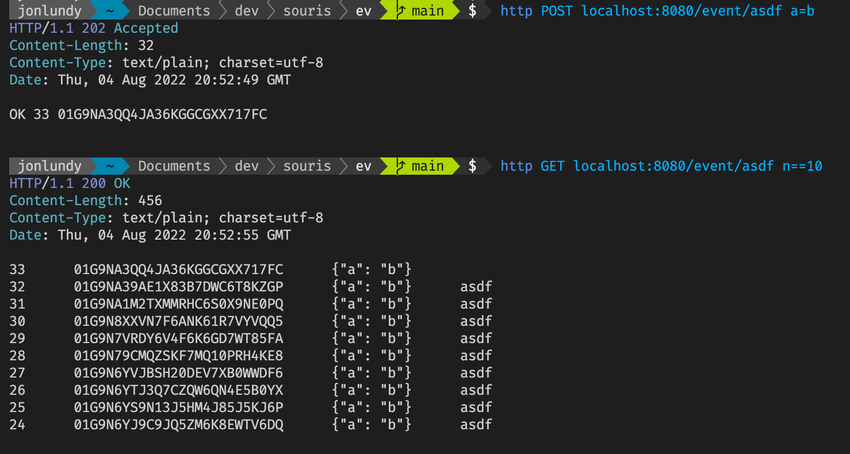
I plan to expand it to handle other event sourcing type things like aggregates and projections.
Find it here: sour-is/ev
@prologic@twtxt.net @movq@www.uninformativ.de @lyse@lyse.isobeef.org
Hi, I am playing with making an event sourcing database. Its super alpha but I thought I would share since others are talking about databases and such.
It’s super basic. Using tidwall/wal as the disk backing. The first use case I am playing with is an implementation of msgbus. I can post events to it and read them back in reverse order.
I plan to expand it to handle other event sourcing type things like aggregates and projections.
Find it here: sour-is/ev
@prologic@twtxt.net @movq@www.uninformativ.de @lyse@lyse.isobeef.org
@carsten@yarn.zn80.net Nice images!
@niplav@niplav.github.io if he’s willing to be even more nerdy he could use https://lojban.org/publications/cll/cll_v1.1_xhtml-section-chunks/section-evidentials.html and possibly color-code them in some less important color than red
↳
In-reply-to
»
I launched a new version of my website (https://kolesnikov.se) last night. What do you think about it? Don't forget to leave a message in my guestbook ;-)
⤋ Read More
@win0err@kolesnikov.se I agree with @prologic@twtxt.net about the text size. Adding content="width=device-width" to your viewport meta tag will help massively with scaling on different device widths.
Eg. The first screenshot is the current site with a device width of 440px and the second is with the updated viewport meta tag.


Other than that, I like the aesthetic of it 😊 It gives me early-ish internet vibes, which I wasn’t online for (I’m a ‘90s baby) but I’ve seen some pretty early websites.
@prologic@twtxt.net: 1. I use classic twtxt client written in Python from console, I like simplicity; 2. Thanks for the feedback about my website! It’s better viewed with old 800x600 monitors, haha
@prologic@twtxt.net, thanks for the information! I’ll update my twtxt.txt file :-)
I grepped access logs and found at least three subscribers! @apex@rawtext.club, @prologic@twtxt.net, and @darch@neotxt.dk, hi there!
Seems I forgot how to use my twtxt client
twtxt auf home.bonn.cafe installiert - von github.com:win0err/twtxt
↳
In-reply-to
»
(#6uo24ta) @chronolink Replies are not part of the original twtxt format. They were added later as an extension by Yarn.social: https://dev.twtxt.net/doc/twtsubjectextension.html (only the section “Machine-Parsable Conversation Grouping” is used these days)
⤋ Read More
Hmm, @prologic@twtxt.net / @lyse@lyse.isobeef.org: Should we remove the section “Traditional Human-Readable Topics” from the spec? Or mark is as deprecated? I haven’t seen this being used in the wild for years. 🤔
@chronolink@chrono.tilde.cafe Replies are not part of the original twtxt format. They were added later as an extension by Yarn.social: https://dev.twtxt.net/doc/twtsubjectextension.html (only the section “Machine-Parsable Conversation Grouping” is used these days)
↳
In-reply-to
»
We moved to the US. When we got back we just never got new chickens again 😢
⤋ Read More
@prologic@twtxt.net Oh.. reading comprehension is strong today.. you went to US and now back.
↳
In-reply-to
»
We moved to the US. When we got back we just never got new chickens again 😢
⤋ Read More
@prologic@twtxt.net Oh.. reading comprehension is strong today.. you went to US and now back.
↳
In-reply-to
»
We moved to the US. When we got back we just never got new chickens again 😢
⤋ Read More
@prologic@twtxt.net Hol-Up. You are state side now? That’s a pretty big change!
↳
In-reply-to
»
We moved to the US. When we got back we just never got new chickens again 😢
⤋ Read More
@prologic@twtxt.net Hol-Up. You are state side now? That’s a pretty big change!
↳
In-reply-to
»
We assembled one of those yesterday: https://www.omlet.de/shop/h%C3%BChnerzucht/walkinrun_h%C3%BChnerauslauf/ Way more exhausting than I thought. 🤣 I’m so sore …
⤋ Read More
@movq@www.uninformativ.de I usually only use eggs for baking or fry them for potatoes and spinach. @prologic@twtxt.net Why don’t you have them anymore? Did the fox get them all when the door didn’t close in time? ]:->
Como ya tengo la cuenta de https://twtxt.net/~eaplmx en inglés, usaré esta de Text-plano en español. Veamos qué tal funciona!
**R to @mind_booster: Foi também em 1997 que saiu o jogo Diablo, cujo impacto nos “novos internautas” vai muito além da comunidade de gaming:
https://twtxt.net/twt/vqon7aa**
Foi também em 1997 que saiu o jogo Diablo, cujo impacto nos “novos internautas” vai muito além da comunidade de gaming:
I realized my twtxt client isn’t validating what it pulls once it gets a valid response when a domain started returning js-heavy parking pages for every URL. Oops. Weekend project, I guess. 🤦🏻
@niplav@niplav.github.io Do you have a particular meaning in mind for “long site”, or do you mean all the possible meanings for “long site”?
@niplav@niplav.github.io and I thought evidentials were invented by the Lojban people or maybe North American amerinds, not Eastern Europeans
@niplav@niplav.github.io I have a favorite line of prose written around here somewhere but it’s only understandable by a tiny slice of gamers with literal-Boomer media sensibilities. Posting it would break the Internet.
Look at the twtxt.net api: https://dev.twtxt.net/doc/api.html
O client do twtxt para o Emacs precisa de um upgrade.
Ainda sem ideia como fazer a migração para o twtxt de uma forma razoável e indolor. O caminho faz-se andando.
So it happened - the twtxt.xyz domain finally expired
@prologic moving around servers, managed to break my twtxt client so using literally the first one I could find
I can’t get twtxt to work properly on my machine so I hope this works
↳
In-reply-to
»
hey @xuu i'm trying to sort of get running your keyproofs thing on my hashbang's site root, but I get this:
⤋ Read More
@novaburst@twt.nfld.uk Ah.. that is probably the XMPP verify code.. it doesnt really work that well. I aught to take it out.
↳
In-reply-to
»
hey @xuu i'm trying to sort of get running your keyproofs thing on my hashbang's site root, but I get this:
⤋ Read More
@novaburst@twt.nfld.uk Ah.. that is probably the XMPP verify code.. it doesnt really work that well. I aught to take it out.
↳
In-reply-to
»
Article: What happens to TLDs when their country stops existing? | aay.tw/e5J71
⤋ Read More
@mutefall@twtxt.net interesting.. were you working on one of the two universities that used it between 1989 and 1991?
↳
In-reply-to
»
Article: What happens to TLDs when their country stops existing? | aay.tw/e5J71
⤋ Read More
@mutefall@twtxt.net interesting.. were you working on one of the two universities that used it between 1989 and 1991?
#event Upcomming Meetup in Copennhagen: algolab(the_art_of_live_coding) @ Støberiet / Computer Klub
hey @xuu@txt.sour.is i’m trying to sort of get running your keyproofs thing on my hashbang’s site root, but I get this:
Apr 01 02:55:25 de1 sour.is-keyproofs[9084]: 2:55AM ERR home/novaburst/keyproofs/main.go:73 > Application Failed error=": missing jid"
↳
In-reply-to
»
@xuu So that means we're allowed to use it right? 😅
⤋ Read More
@prologic@twtxt.net yeah. For commercial use even. Just need to put an attribution note in the project README
↳
In-reply-to
»
@xuu So that means we're allowed to use it right? 😅
⤋ Read More
@prologic@twtxt.net yeah. For commercial use even. Just need to put an attribution note in the project README
↳
In-reply-to
»
@prologic @ullarah I often see messages longer than what the textbox limit is, isn't it limited by the
⤋ Read More
maxlenght?, I found a workaround by writing from Goryon on mobile, on PC i can simply change the limit with the inspector but isn't it there for a reason?
@mckinley@twtxt.net Agreed! 👌
Can we all vote on the new default being 1024 then perhaps? 🤔
+1 from me
↳
In-reply-to
»
Anyone good with designing logos? Salty IM needs one fast! 😅
⤋ Read More
@xuu@txt.sour.is So that means we’re allowed to use it right? 😅
↳
In-reply-to
»
Anyone good with designing logos? Salty IM needs one fast! 😅
⤋ Read More
@prologic@twtxt.net if we do adopt this one it is CC-BY from twitter. https://twemoji.twitter.com
↳
In-reply-to
»
Anyone good with designing logos? Salty IM needs one fast! 😅
⤋ Read More
@prologic@twtxt.net if we do adopt this one it is CC-BY from twitter. https://twemoji.twitter.com
@prologic@twtxt.net @ullarah@txt.quisquiliae.com I often see messages longer than what the textbox limit is, isn’t it limited by the maxlenght?, I found a workaround by writing from Goryon on mobile, on PC i can simply change the limit with the inspector but isn’t it there for a reason?
I too would like to express a bit more if possible, especially if i have to refer to users and link URLs and images for example, having a limit that isn’t too much of a limit is kind of pointless i think. 🤔
↳
In-reply-to
»
Alright, check this out. I just kinda completed today's project of converting a jeans into a saw bag. It's not fully done, the side seams on the flap need some more hand sewing, that's for sure. No, I don't have a sewing machine. Yet?
⤋ Read More
@lyse@lyse.isobeef.org Excellent use of old denim, and also excellent use of long-form twt!
@adi@twtxt.net Also, I noticed you followed me on Twitter, but you might enjoy @anths if you want techie stuff instead of Oregon politics. 🤣
I just spent an hour setting up the header of my twtxt.txt file ¯_(ツ)_/¯
I’ve made some fixes to twtxt to make it work with Python 3.7+. I hope @buckket@buckket.org will apply this patch!
Back to twtxt from the cli with twet https://github.com/jdtron/twet
Back to twtxt from the cli with twet https://github.com/jdtron/twet
Hello! world. First post on twtxt
↳
In-reply-to
»
@prologic yarn builds in 1.18!
⤋ Read More
@novaburst@twt.nfld.uk I doubt there will ever be a 2.0 … It may end up like java and they strip off the 1.
↳
In-reply-to
»
@prologic yarn builds in 1.18!
⤋ Read More
@novaburst@twt.nfld.uk I doubt there will ever be a 2.0 … It may end up like java and they strip off the 1.
↳
In-reply-to
»
@ullarah Didn't we talk about at some point a way to set the maximum height of te panels with some UX way to read the rest? 🤔 Is that still on the cards or a bad ideas? 🤔
⤋ Read More
@ullarah@txt.quisquiliae.com works for me! A tricky bitmight be if it splits within a codeblock so markdown can’t parse
↳
In-reply-to
»
@prologic Media
⤋ Read More
@ullarah@txt.quisquiliae.com Didn’t we talk about at some point a way to set the maximum height of te panels with some UX way to read the rest? 🤔 Is that still on the cards or a bad ideas? 🤔
#!/bin/sh

# Validate environment
if ! command -v msgbus > /dev/null; then
    printf "missing msgbus command. Use:  go install git.mills.io/prologic/msgbus/cmd/msgbus@latest"
    exit 1
fi

if ! command -v salty > /dev/null; then
    printf "missing salty command. Use:  go install go.mills.io/salty/cmd/salty@latest"
    exit 1
fi

if ! command -v salty-keygen > /dev/null; then
    printf "missing salty-keygen command. Use:  go install go.mills.io/salty/cmd/salty-keygen@latest"
    exit 1
fi

if [ -z "$SALTY_IDENTITY" ]; then
    export SALTY_IDENTITY="$HOME/.config/salty/$USER.key"
fi

get_user () {
    user=$(grep user: "$SALTY_IDENTITY" | awk '{print $3}')
    if [ -z "$user" ]; then
        user="$USER"
    fi
    echo "$user"
}

stream () {
    if [ -z "$SALTY_IDENTITY" ]; then
        echo "SALTY_IDENTITY not set"
        exit 2
    fi

    jq -r '.payload' | base64 -d | salty -i "$SALTY_IDENTITY" -d
}

lookup () {
    if [ $# -lt 1 ]; then
    printf "Usage: %s nick@domain\n" "$(basename "$0")"
    exit 1
    fi

    user="$1"
    nick="$(echo "$user" | awk -F@ '{ print $1 }')"
    domain="$(echo "$user" | awk -F@ '{ print $2 }')"

    curl -qsSL "https://$domain/.well-known/salty/${nick}.json"
}

readmsgs () {
    topic="$1"

    if [ -z "$topic" ]; then
        topic=$(get_user)
    fi

    export SALTY_IDENTITY="$HOME/.config/salty/$topic.key"
    if [ ! -f "$SALTY_IDENTITY" ]; then
        echo "identity file missing for user $topic" >&2
        exit 1
    fi

    msgbus sub "$topic" "$0"
}

sendmsg () {
    if [ $# -lt 2 ]; then
        printf "Usage: %s nick@domain.tld <message>\n" "$(basename "$0")"
        exit 0
    fi

    if [ -z "$SALTY_IDENTITY" ]; then
        echo "SALTY_IDENTITY not set"
        exit 2
    fi

    user="$1"
    message="$2"

    salty_json="$(mktemp /tmp/salty.XXXXXX)"

    lookup "$user" > "$salty_json"

    endpoint="$(jq -r '.endpoint' < "$salty_json")"
    topic="$(jq -r '.topic' < "$salty_json")"
    key="$(jq -r '.key' < "$salty_json")"

    rm "$salty_json"

    message="[$(date +%FT%TZ)] <$(get_user)> $message"

    echo "$message" \
        | salty -i "$SALTY_IDENTITY" -r "$key" \
        | msgbus -u "$endpoint" pub "$topic"
}

make_user () {
    mkdir -p "$HOME/.config/salty"

    if [ $# -lt 1 ]; then
        user=$USER
    else
        user=$1
    fi

    identity_file="$HOME/.config/salty/$user.key"

    if [ -f "$identity_file" ]; then
        printf "user key exists!"
        exit 1
    fi

    # Check for msgbus env.. probably can make it fallback to looking for a config file?
    if [ -z "$MSGBUS_URI" ]; then
        printf "missing MSGBUS_URI in environment"
        exit 1
    fi


    salty-keygen -o "$identity_file"
    echo "# user: $user" >> "$identity_file"

    pubkey=$(grep key: "$identity_file" | awk '{print $4}')

    cat <<- EOF
Create this file in your webserver well-known folder. https://hostname.tld/.well-known/salty/$user.json

{
  "endpoint": "$MSGBUS_URI",
  "topic": "$user",
  "key": "$pubkey"
}

EOF
}

# check if streaming
if [ ! -t 1 ]; then
    stream
    exit 0
fi

# Show Help
if [ $# -lt 1 ]; then
    printf "Commands: send read lookup"
    exit 0
fi


CMD=$1
shift

case $CMD in
    send)
        sendmsg "$@"
    ;;
    read)
        readmsgs "$@"
    ;;
    lookup)
        lookup "$@"
    ;;
    make-user)
        make_user "$@"
    ;;
esac
↳
In-reply-to
»
For instance I normally use the same RSA key/pair on all my workstations for my
⤋ Read More
ssh client, because that's me, no-matter where I am. The only exception to this rule is I usually create a separate key for any "work" / " company" I am a part of.
@prologic@twtxt.net I have seen single use keys that are signed by a central PKI .. Keybase has one that uses a chatbot to generate the keys on the fly.
It just comes down to your threat model :)
↳
In-reply-to
»
For instance I normally use the same RSA key/pair on all my workstations for my
⤋ Read More
ssh client, because that's me, no-matter where I am. The only exception to this rule is I usually create a separate key for any "work" / " company" I am a part of.
@prologic@twtxt.net for shame! lol me too.
@prologic@twtxt.net yarn builds in 1.18!
@prologic@twtxt.net yarn builds in 1.18!
@prologic@twtxt.net Re: Chat system, What if the base specification included a system for per-user arbitrary JSON storage on the server? Kind of like XEP-0049, but expanded upon. Two kinds of objects: public and private. Public objects can be queried by anyone, private objects cannot and must be encrypted with the user’s private key. Public keys could be stored there, as well as anything else defined by extensions. Roster, user block list, avatar, etc.
@prologic@twtxt.net hmm so each individual feed on your pod sub’s my feed? Wouldn’t that flood your server for each post?
@prologic@twtxt.net hmm so each individual feed on your pod sub’s my feed? Wouldn’t that flood your server for each post?
↳
In-reply-to
»
This is interesting ...
⤋ Read More
↳
In-reply-to
»
This is interesting ...
⤋ Read More
@prologic@twtxt.net … Australia, or The US when visiting www.om.gay
@prologic@twtxt.net it’s already been set-up, depending where you are you’ll be connected to Norway, South Africa…
@prologic@twtxt.net basically spread the load, got rclone to spoof out the content, et voilÃ
@prologic@twtxt.net on the cheap, I have 4 web hosting accounts used for various things in the past in places
@niplav@niplav.github.io 3½ hours a week…closing your 30-minute Exercise ring right on the dot, with no extra time?
From now on, my twtxt feed is gpg signed. I hope this works for everyone.
Hmm. I haven’t used twtxt in a while. How are you doing?
↳
In-reply-to
»
(#fediadq) @kevin You got an English translation of this page? 🤔 Media
⤋ Read More
@prologic@twtxt.net if you need to translate Ukrainian Lingvanex appears to be the best https://lingvanex.com/demo/