Security updates for Tuesday
Security updates have been issued by AlmaLinux (gimp, libxslt, python3.11, python3.12, and tomcat), Debian (ghostscript and libnet-easytcp-perl), Fedora (openvpn, perl-Data-Entropy, and webkitgtk), Red Hat (python-jinja2), SUSE (giflib, pam, and xen), and Ubuntu (apache2, binutils, expat, fis-gtm, linux-azure, linux-azure-6.8, linux-nvidia-lowlatency, linux-azure, linux-azure-fde, linux-azure-5.15, linux-azure-fde-5.15, linux-azure-fips, linux-gcp-fips, linux-hwe-5.4, linux-nvidia, … ⌘ Read more
PEP 785: New methods for easier handling of ExceptionGroup\ s
As PEP 654 ExceptionGroup has come into widespread use across the Python community, some common but awkward patterns have emerged. We therefore propose adding two new methods to exception objects: ⌘ Read more
PEP 784: Adding Zstandard to the standard library
Zstandard is a widely adopted, mature, and highly efficient compression standard. This PEP proposes adding a new module to the Python standard library containing a Python wrapper around Meta’s zstd library, the default implementation. Additionally, to avoid name collisions with packages on PyPI and to present a unified interface to Python users, compression modules in the standard library will be moved under a compression.* namespace package. ⌘ Read more
How can you pass command line arguments to a Python script when using the filter command ⌘ Read more
Security updates for Thursday
Security updates have been issued by AlmaLinux (expat), Debian (chromium, commons-vfs, firefox-esr, php-horde-editor, php-horde-imp, and thunderbird), Fedora (corosync, firefox, nextcloud, and suricata), Mageia (curl and upx), Oracle (emacs, fence-agents, freetype, kernel, libreoffice, libxml2, nginx:1.24, podman, python-jinja2, and tigervnc), Red Hat (firefox and python-jinja2), SUSE (assimp, ffmpeg-4, firefox, ghostscript, GraphicsMagick, libxslt, and tomcat), and Ubuntu … ⌘ Read more
Security updates for Tuesday
Security updates have been issued by AlmaLinux (freetype, grub2, kernel, kernel-rt, and python-jinja2), Debian (freetype, linux-6.1, suricata, tzdata, and varnish), Fedora (mingw-libxslt and qgis), Mageia (elfutils, mercurial, and zvbi), Oracle (grafana, kernel, libxslt, nginx:1.22, and postgresql:12), Red Hat (opentelemetry-collector), SUSE (corosync, opera, and restic), and Ubuntu (aom, libtar, mariadb, ovn, php7.4, php8.1, php8.3, rabbitmq-server, and webkit2gtk). ⌘ Read more
Security updates for Monday
Security updates have been issued by Debian (amd64-microcode, flatpak, intel-microcode, libdata-entropy-perl, librabbitmq, and vim), Fedora (augeas, containerd, crosswords-puzzle-sets-xword-dl, libssh2, libxml2, nodejs-nodemon, and webkitgtk), Red Hat (libreoffice and python-jinja2), SUSE (389-ds, apparmor, corosync, docker, docker-stable, erlang26, exim, ffmpeg-4, govulncheck-vulndb, istioctl, matrix-synapse, mercurial, openvpn, python3, rke2, and skopeo), and Ubuntu (ansible, linux, l … ⌘ Read more
PEP 782: Add PyBytesWriter C API
Add a new PyBytesWriter C API to create bytes objects. ⌘ Read more
Thank you @python_valencia@twtxt.python-valencia.es for letting me show you the secrets of a decentralised plain text social network like twtxt.
I hope you enjoyed the talk! ❤️🐍
#python #twtxt
I want to present the twtxt feed from Python Valencia: https://twtxt.python-valencia.es/
Technical curiosity: It is generated using n8n, using the official rss.
#welcome
Security updates for Wednesday
Security updates have been issued by Debian (nginx and ruby-rack), Fedora (expat and libxslt), Mageia (bluez, dcmtk, ffmpeg, and radare2), Red Hat (container-tools:rhel8, gvisor-tap-vsock, kernel, kernel-rt, libreoffice, and podman), SUSE (buildah, forgejo, gitleaks, google-guest-agent, google-osconfig-agent, govulncheck-vulndb, grafana, helm, libxslt, php8, python-gunicorn, and python-Jinja2), and Ubuntu (freerdp2 and varnish). ⌘ Read more
↳
In-reply-to
»
I now subscribed to most feeds in my Go
⤋ Read More
tt reimplementation that I already followed with the old Python tt. Previously, I just had a few feeds for testing purposes in my new config. While transfering, I "dropped" heaps of feeds that appeared to be inactive.
Thanks, @movq@www.uninformativ.de!
My backing SQLite database with indices is 8.7 MiB in size right now.
The twtxt cache is 7.6 MiB, it uses Python’s pickle module. And next to it there is a 16.0 MiB second database with all the read statuses for the old tt. Wow, super inefficient, it shouldn’t contain anything else, it’s a giant, pickled {"$hash": {"read": True/False}, …}. What the heck, why is it so big?! O_o
I now subscribed to most feeds in my Go tt reimplementation that I already followed with the old Python tt. Previously, I just had a few feeds for testing purposes in my new config. While transfering, I “dropped” heaps of feeds that appeared to be inactive.
This might motivate me to actually “finish” the new client, so that it could become my daily driver. No need to use the old software stack any longer. Let’s see how bad this goes.
Security updates for Tuesday
Security updates have been issued by Debian (ruby-rack), Fedora (chromium, golang-github-openprinting-ipp-usb, OpenIPMI, and python-jinja2), Mageia (kernel, kernel-linus, and wpa_supplicant, hostapd), Red Hat (fence-agents, kernel, kernel-rt, libxml2, libxslt, and pcs), SUSE (cadvisor, docker, freetype2, nodejs-electron, php8, rsync, u-boot, warewulf4, webkit2gtk3, and zvbi), and Ubuntu (elfutils, python3.5, python3.8, ruby-rack, smartdns, and zvbi). ⌘ Read more
↳
In-reply-to
»
When will the flat UI craze end? Can I get my buttons, scrollbars, and toolbars back, please?
⤋ Read More
@movq@www.uninformativ.de Yeah, most of the graphical applications are actually KDE programs:
- KMail – e-mail client
- Okular – PDF viewer
- Gwenview – image viewer
- Dolphin – file browser
- KWallet – password manager (I want to check out
passone day. The most annoying thing is that when I copy a password, it says that the password has been modified and asks me whether I want to save the changes. I never do, because the password is still the same. I don’t get it.)
- KPatience – card game
- Kdenlive – video editor
- Kleopatra – certificate manager
Qt:
- VLC – video player
- Psi – Jabber client (I happily used Kopete in the past, but that is not supported anymore or so. I don’t remember.)
- sqlitebrowser – SQLite browser
Gtk:
- Firefox – web browser
- Quod Libet – music player (I should look for a better alternative. Can’t remember why I had to move away from Amarok, was it dead? There was a fork Clementine or so, but I had to drop that for some unknown reason, too.)
- Audacity – audio editor
- GIMP – image editor
These are the things that are open right now or that I could think of. Most other stuff I actually do in the terminal.
In the past™, I used the Python KDE4 bindings. That was really nice. I could pass most stuff directly in the constructor and didn’t have to call gazillions of setters improving the experience significantly. If I ever wanted to do GUI programming again, I’d definitely go that route. There are also great Qt bindings for Python if one wanted to avoid the KDE stuff on top. The vast majority I do for myself, though, is either CLI or maybe TUI. A few web shit things, but no GUIs anymore. :-)
↳
In-reply-to
»
Wow, this is a nice way to practice internationalization for our systems
https://i18n-puzzles.com
⤋ Read More
I have finished 1-9 on Python. If anyone is interested, I could share the code, or in Reddit many people have shared theirs.
In a couple of days I’ll be giving a talk about #twtxt https://www.meetup.com/es-ES/python-valencia-meetup/events/306769708/
PEP 780: ABI features as environment markers
This PEP defines using ABI features as environment markers for project dependencies, through a new sys_abi_features environment marker and sys.abi_features attribute in the sys module. PEP 508 (later moved to packaging:dependency-specifiers) introduced environment markers to specify dependencies based on rules that describe when the dependency should be used. This PEP extends the environment markers to allow specifying dependencies based on specific ABI features of the Python interprete … ⌘ Read more
Security updates for Thursday
Security updates have been issued by Debian (php7.4, python-django, and python3.9), Fedora (bluez, iwd, libell, and radare2), Mageia (chromium-browser-stable, mosquitto, tomcat, tomcat packages, and vim), Oracle (firefox, grub2, python3, thunderbird, and webkit2gtk3), Red Hat (fence-agents, php:7.4, and python-jinja2), SUSE (assimp-devel, crane, ffmpeg-4, freetype2, helm, kernel, kured, python-Django, python-Jinja2, python311-Django4, and tomcat), and Ubuntu (alpine, djoser, l … ⌘ Read more
golang 每日一庫之 gopsutil
shirou/gopsutil 是一個用 Go 語言實現的跨平臺系統信息採集庫,其設計靈感來源於 Python 的 psutil。它爲開發者提供了一套統一、簡潔的 API,用於獲取底層操作系統的各項指標數據,如 CPU、內存、磁盤、網絡、主機信息以及進程狀態等。下面我們將從多個方面詳細介紹這個庫的功能、設計特點、使用示例以及應用場景。庫簡介——跨平臺支持 gopsutil ⌘ Read more
PEP 776: Emscripten Support
Emscripten is a complete open source compiler toolchain. It compiles C/C++ code into WebAssembly/JavaScript executables, for use in JavaScript runtimes, including browsers and Node.js. The Rust language also maintains an Emscripten target. ⌘ Read more
Go 語言中的 LangGraph:基於 LangGraphgo 的 AI 任務編排
在 AI 任務編排領域,LangChain 提供了 LangGraph,幫助開發者搭建複雜、多步驟、有狀態的 AI 工作流。但這個庫主要基於 Python,而在 Go 語言生態中,如何實現類似的 AI 任務編排呢?今天,我們來介紹 langgraphgo,一個爲 Golang 量身定製的 AI 任務流管理框架。通 langgraphgo,你可以高效地構建 AI 代碼審計、對話系統、多智能體協作等應 ⌘ Read more
PEP 779: Criteria for supported status for free-threaded Python
The acceptance of PEP 703 (Making the Global Interpreter Lock Optional in CPython), as announced by the Steering Council, describes three phases of development for the work to remove the Global Interpreter Lock. Phase I started early in the development of Python 3.13, and includes making the free-threaded (GIL-less) Python build available but explicitly experimental. Phase II would make the free-threaded build officially supported but still optional, and phase III would … ⌘ Read more
↳
In-reply-to
»
The other day, after a discussion online, we came to the conclusion that using awk+sed+tr could replace much of the development that requires a database. However, using SQLite to have a SQL syntax isn't a bad idea either. What do you think?
⤋ Read More
@andros@twtxt.andros.dev If something fits in a CSV file, it typically doesn’t require a database. I agree with that. Depending on the application, more complicated queries might benefit from a database, though. I don’t know awk very well, but I could imagine that grep, sed and cut reach their CSV processing limits rather quickly when you have to deal with escaped (multiline) fields.
I only very rarely have to deal with CSV files or databases in my day to day life. Maybe, these classic Unix tools offer some tricks I’m not aware of. When I have some more complicated CSV input, I generally reach for Python.
Ontem voltei a pegar no Django depois de 10 anos para um side-project. É como se fosse um regresso a um lugar onde um dia se foi feliz.
Tem a sua personalidade e tal, mas continuo a adorar os seus pormenores e as suas escolhas sobre como deve funcionar uma framework web.
Também fiquei muito agradado de ver que muito pouco mudou desde há uma década no que toca à forma fundamental como o Django faz as coisas. Talvez isso não seja apreciado pela juventude habituada a ciclos de upgrade rápidos e drásticos, mas pra mim foi um grande alívio ver que não tenho de me atualizar muito para montar um pequeno projeto.
Há gente djangueira por aí?
yaegi:讓你的 Go 代碼擁有動態腳本能力
在 Go 語言的世界裏,靜態編譯是其一大特色,能夠保證性能和安全性。然而,有些場景下,我們希望像 Python 或 JavaScript 一樣,支持運行時動態執行代碼,比如插件化架構、規則引擎、腳本解釋器等。今天,我們來介紹一個強大的 Go 解釋器庫——yaegi,它能讓 Go 代碼在運行時執行動態腳本。yaegi 簡介yaegi 是一個用 Go 語言編寫的 Go 解釋器。它可以在運行時解析和執行 ⌘ Read more
↳
In-reply-to
»
@andros, I am getting:
⤋ Read More
looks good now!
description = 🏗 Full-Stack developer (Mainly Python) ✍ Writer[...]
PEP 775: Make zlib required to build CPython
Building CPython without the zlib compression library will no be longer supported, and the zlib module will be required in the standard library. The only exception is WASI, as zlib is not currently supported in CPython on WASI. Building the interpreter without zlib may still be possible, but formally unsupported. ⌘ Read more
I’m developing a tutorial for the Django Girls. Does anyone here have experience with #Django ? #python
↳
In-reply-to
»
Have you ever had to refactor a project that was not documented? Any suggestions?
⤋ Read More
The project is a POC (Proof of Concept) that went into production and the company has customers who are using it. The developers had been working for several years, without testing, structure, isolation and so on. The company hired me to transform the project into a real product. There are in my hands 422 python files to transform that they beg me a refactore, architecture and testing. Every developer’s bad dream.
My first step is to read and understand the tree because there are apps inside other apps call each other. I am very determined to work on a new repository.
↳
In-reply-to
»
My take on the discussion to introduce an
⤋ Read More
? operator in Go 👈 No. For so many reasons.
@prologic@twtxt.net Which one? I don’t mind the ternary operator at all. In fact, I often find myself missing it in Go. I don’t find the two alternatives particularly elegant:
foo := "eggs"
if bar {
    foo = "spam"
}
Or:
var foo string
if bar {
    foo = "spam"
} else {
    foo = "eggs"
}
To my eye, this just would look a lot nicer:
foo := bar ? "spam" : "eggs"
Or at least as the Pythons do it:
foo = "spam" if bar else "eggs"
The ternary operator especially shines with relatively short expressions.
For many years I have found Flask to be too basic a tool for modern development. But since I create APIs using Flask with Pydantic to validate the input data, some middlewares for parsing and Blueprint to separate the code into modules… I must admit that I am super comfortable, fast and easy to test.
#flask #python #pydantic
PEP 774: Removing the LLVM requirement for JIT builds
Since Python 3.13, CPython has been able to be configured and built with an experimental just-in-time (JIT) compiler via the –enable-experimental-jit flag on Linux and Mac and –experimental-jit on Windows. To build CPython with the JIT enabled, users are required to have LLVM installed on their machine (initially, with LLVM 16 but more recently, with LLVM 19). LLVM is responsible for generating stencils that are essential to our copy-and-patch JIT (see PEP 744). These stencils a … ⌘ Read more
Anon donates ~23 XMR to Monero General Fund
An anonymous contributor has donated a total of 23.4965657 XMR (~5.1K USD)1 to the Monero General Fund address2.
plowsof’s monero-fund-watch 3 Python script tweeted4 the donation alert earlier today:
💝 +23.4965657 #xmr 💝 $5155.15
This is an ongoing story and the report will be updated when new information is available.
↳
In-reply-to
»
I share a simple API template with Clean Architecture using #flask and #fastapi
https://git.andros.dev/andros/api-template-with-clean-architecture
#cleancode #cleanarchitecture
⤋ Read More
What is clean architecture? That’s a good question.
You think of a pattern for ordering code with good decisions isolating technologies (you can change the web framework or database without break the business logic), easy to test (you only test interfaces and use cases), sharing code between frameworks (entities and use cases), scalability, modulations and standardizing names. Clean architecture is not perfect, it has a learning curve and some abstraction in each technology. You can even find rejection with yours colleagues.
I have a good article on this topic.
https://programadorwebvalencia.com/implementando-arquitectura-limpia-en-python/
#python
[LFH] Revuo Monero is looking for python and golang (hugo) contributors!
There are a handful of open issues in Revuo Monero’s repositories: Calc and main. Feel free to take a peek and help if you are capable of and got the volunteering enthusiasm in you!
Links:
rottenwheel.com ⌘ Read more
PEP 773: A Python Installation Manager for Windows
Installation of the python.org Python distribution on Windows is complex. There are three main approaches with roughly equivalent levels of user experience, and yet all of these suffer from different limitations, including failing to satisfy modern usage scenarios. This PEP proposes a design for a single Windows install workflow tool that satisfies all the needs of the existing installers for the platform, while avoiding most of their limitations, and provides the core team with the … ⌘ Read more
↳
In-reply-to
»
@doesnm Is that implementing IndieAuth? 🤔
⤋ Read More
Yes, it’s a mini python cgi script which implements IndieAuth
↳
In-reply-to
»
i love posting to my own personal youtube site i can just do whatever tf i want. no content ID here just vibes and finger crossing that i don't get a cease and desist one day
⤋ Read More
@prologic@twtxt.net mediacms! it’s janky yeah but it does the job ultimately (even if sometimes videos don’t encode and i gotta do some weird python venv shit to force the encode lol…)
The fact that the official Python docs don’t clearly state what a function returns, grinds my gears. This has cost me so much time over the years. You always have to read through a huge block of text.
You could at least put a list of possible return values in there (always at the same location, please!), here’s a mockup:
I want to share the video of my last talk: Creating an Instagram in Django for an Iberian lynx https://www.youtube.com/watch?v=dW69cYIULh8 (Spanish) #django #python
PEP 770: Improving measurability of Python packages with Software Bill-of-Materials
Software Bill-of-Materials (SBOM) is a technology-and-ecosystem-agnostic method for describing software composition, provenance, heritage, and more. SBOMs are used as inputs for software composition analysis (SCA) tools, such as scanners for vulnerabilities and licenses, and have been gaining traction in global software regulations and frameworks. ⌘ Read more
everoddandeven proposes bounty for monero-cpp Python bindings module
everoddandeven1 has proposed a bounty2 for creating a Python module that exposes the core functionalities of the monero-cpp library 3:
This module should enable Python developers to interact with monero-cpp API using a Pythonic interface without needing to write or interact with C++ code directly.
Total Bounty: 0 XMR (to date)
- Code is ope … ⌘ Read more
01Studio CanMV K230 Python Powered AI Development Board with RISC V Edge Computing
The distributor Youyeetoo recently highlighted the 01Studio CanMV K230 AI development board, built on Canaan’s K230 chip. This board includes features such as neural network acceleration, flexible camera interfaces, 4K video support, and onboard Wi-Fi connectivity. CanMV is an open-source project maintained by Canaan, aimed at integrating Python-based programming into edge AI app … ⌘ Read more
↳
In-reply-to
»
@doesnm How did you post from IndiePass? Did you add support for twtxt or use some kind of bridge?
⤋ Read More
python cgi script which handles micropub and writes content to twtxt file. I was want micropub+microsub for twtverse but seems i burned (due choice wrong stack?): https://privatebin.net/?0b598b91ac186855#BfRKjLUQz5KUFJNekJBb5V2qvtEe8xQN8nenYbkez2XR
Introducing Annotated Logger: A Python package to aid in adding metadata to logs
We’re open sourcing Annotated Logger, a Python package that helps make logs searchable with consistent metadata.
The post [Introducing Annotated Logger: A Python package to aid in adding metadata to logs](https://github.blog/developer-skills/programming-languages-and-frameworks/introducing-annotated-logger-a-python-package-to-aid-in-a … ⌘ Read more
Al “Slop” Bug Reports Hurting Python, Curl, & Other Open Source Projects
“Low-quality, spammy, and LLM hallucinated security reports” taking time away from real bugs and features. ⌘ Read more
在 Go 中如果獲取 goroutine 的 id?
如果你使用過如 Python、Java 等主流支持併發的編程語言,那麼通常都能夠比較容易的獲得進程和線程的 id。但是在 Go 語言,沒有直接提供對多進程和多線程的支持,而是提供了 goroutine 來支持併發編程。不過在 Go 中,獲取 goroutine 的 id 並不像其他編程語言那樣容易,但依然有辦法,本文就來介紹下如何實現。獲取當前進程的 id首先,雖然 Go 沒有提供多進程編程,但啓 ⌘ Read more
The “Code of Conduct” Must Die
The “CoC” concept has done more harm than good, weaponized against people in Linux, NixOS, Python, C++, openSUSE, Godot, and many other organizations. ⌘ Read more
PEP 768: Safe external debugger interface for CPython
This PEP proposes adding a zero-overhead debugging interface to CPython that allows debuggers and profilers to safely attach to running Python processes. The interface provides safe execution points for attaching debugger code without modifying the interpreter’s normal execution path or adding runtime overhead. ⌘ Read more
PEP 766: Explicit Priority Choices Among Multiple Indexes
Package resolution is a key part of the Python user experience as the means of extending Python’s core functionality. The experience of package resolution is mostly taken for granted until someone encounters a situation where the package installer does something they don’t expect. The installer behavior with multiple indexes has been a common source of unexpected behavior. Through its ubiquity, pip has long defined the standard expected behavior across other tools in the ecosy … ⌘ Read more
PEP 765: Disallow return/break/continue that exit a finally block
This PEP proposes to withdraw support for return, break and continue statements that break out of a finally block. This was proposed in the past by PEP 601. The current PEP is based on empirical evidence regarding the cost/benefit of this change, which did not exist at the time that PEP 601 was rejected. It also proposes a slightly different solution than that which was proposed by PEP 601. ⌘ Read more
nahuhh releases ‘basicswap-bash’ v0.14.1
nahuhh (ofrnxmr)1 has released basicswap-bash 2 version 0.14.13:
Changes overviewA suite of bash scripts to install and manage BasicSwapDEX on Windows(WSL)/Debian/Ubuntu/Arch/Fedora
* placeorders: use python to check offer size
* setup: update tails
* fix $PATH detection
* fix restore from seed
* install: xfce .profile use in .xsessionrc
Installation instructions are available on the Github release page3.
… ⌘ Read more
Octoverse: AI leads Python to top language as the number of global developers surges
In this year’s Octoverse report, we study how public and open source activity on GitHub shows how AI is expanding as the global developer community surges in size.
The post Octoverse: AI leads Python to top language as the number of global developers surges appeared first on The GitHub Blog. ⌘ Read more
m-a-x-c creates Monero churn timing tool
m-a-x-c1 has created Monero Churn Timer 2 - a Python script that generates randomized wait times for XMR transactions and can potentially help users increase their privacy by scheduling churns:
The way it works is as follows: after receiving Monero, you would use the Monero Churn Timer to generate a random wait time. You would then set a reminder to “churn” (i.e., send that transaction to yourself at a new address) after the specified … ⌘ Read more
[ANN] Looking for intermediate/advanced Django/Python developer to fix and maintain moneroj.net!
Please reach out as soon as possible so we can bring the website back up, after looking at what broke and fixing it, plus optionally we can keep working together for the foreseeable future so we implement new features or refactor things around.
Links:
rottenwheel.com ⌘ Read more
PEP 763: Limiting deletions on PyPI
We propose limiting when users can delete files, releases, and projects from PyPI. A project, release, or file may only be deleted within 72 hours of when it is uploaded to the index. From this point, users may only use the “yank” mechanism specified by PEP 592. ⌘ Read more
PEP 8106: 2025 Term Steering Council election
This document describes the schedule and other details of the 2024 election for the Python steering council, as specified in PEP 13. This is the steering council election for the 2025 term (i.e. Python 3.14). ⌘ Read more
[AFH] [€20/hr] Python Engineer for ETL services (6 years of experience)
Link: https://farside.link/libreddit/r/forhire/comments/1g5qtwr/
u/ILOTEbunny (Reddit) ⌘ Read more
ErikASD creates XMR payment processor that uses PGP login system
ErikASD1 has created simpyle-xmr-processor 2 - a Python-based concept Monero payment processor that credits accounts using a PGP login system:
I was interested on which the best way to accept XMR programmatically and made this concept payment processor that credits PGP based accounts with the XMR amount deposited like an exchange would have with sub addresses assigned to each account.3
To h … ⌘ Read more
PEP 762: REPL-acing the default REPL
One of Python’s core strengths is its interactive mode, also known as the Read-Eval-Print Loop (REPL), or the Python console, or the Python shell. This PEP describes the new implementation of this functionality written in Python. The new REPL released in Python 3.13 aims to provide modern features expected by today’s users, such as multi-line editing, syntax highlighting, custom commands, and an overall improved interactive experience. ⌘ Read more
↳
In-reply-to
»
@doesnm Agree. salty.im should allow the user to post multiple brokers on their webfinger so the client can find a working path.
⤋ Read More
Honestly… not much. Have abandon two projects (both private) on Golang and one related to cryptography. My mostly languages are Python and Javascript (also can PHP). After writing code on Go i spend same time on fixing dumb errors
PEP 761: Deprecating PGP signatures for CPython artifacts
Since Python 3.11.0, CPython has provided two verifiable digital signatures for all CPython artifacts: PGP and Sigstore. ⌘ Read more
[AFH] [€20/hr] Data processing services by Python dev with 6 yrs of experience
Link: https://farside.link/libreddit/r/forhire/comments/1fv9qe2/
u/ILOTEbunny (Reddit) ⌘ Read more
PEP 758: Allow except and except* expressions without parentheses
This PEP 1 proposes to allow unparenthesized except and except* blocks in Python’s exception handling syntax. Currently, when catching multiple exceptions, parentheses are required around the exception types. This was a Python 2 remnant. This PEP suggests allowing the omission of these parentheses, simplifying the syntax, making it more consistent with other parts of the syntax that make parentheses optional, and improving readability in certain cases. ⌘ Read more
↳
In-reply-to
»
@movq Non-ASCII characters were broken. Like U+2028, degrees (°), etc.
⤋ Read More
Now WTF!? Suddenly, @falsifian@www.falsifian.org’s feed renders broken in my tt Python implementation. Exactly what I had with my Go rewrite. I haven’t touched the Python stuff in ages, though. Also, tt and tt2 do not share any data at all.
By any chance, did you remove the ; charset=utf-8 from your Content-Type: text/plain header, falsifian?
PEP 756: Add PyUnicode_Export() and PyUnicode_Import() C functions
Add functions to the limited C API version 3.14: ⌘ Read more
↳
In-reply-to
»
On the Subject of Feed Identities; I propose the following:
⤋ Read More
@mckinley@twtxt.net To answer some of your questions:
Are SSH signatures standardized and are there robust software libraries that can handle them? We’ll need a library in at least Python and Go to provide verified feed support with the currently used clients.
We already have this. Ed25519 libraries exist for all major languages. Aside from using ssh-keygen -Y sign and ssh-keygen -Y verify, you can also use the salty CLI itself (https://git.mills.io/prologic/salty), and I’m sure there are other command-line tools that could be used too.
If we all implemented this, every twt hash would suddenly change and every conversation thread we’ve ever had would at least lose its opening post.
Yes. This would happen, so we’d have to make a decision around this, either a) a cut-off point or b) some way to progressively transition.
PEP 755: Implicit namespace policy for PyPI
This PEP codifies an implementation of PEP 752 for PyPI 1. ⌘ Read more
Go 機器學習框架之火重燃,Google 前研究員開源期望媲美 Jax 的 GoMLX
Go 作爲一門兼具高性能與簡潔性的編程語言,近年來在各種領域得到廣泛應用。然而,在機器學習領域,Go 相比 Python、C++、Julia 等語言,生態仍然較爲薄弱。目前的 Go 機器學習框架無論在功能全面性上,還是在社區生態支持上都難以與 TensorFlow、PyTorch、Jax 等重量級框架抗衡。究其原因,筆者覺得還是 Go 社區缺少熟悉和精通機器學習方面的人才。不過,隨着時間的推移,總 ⌘ Read more
I love shell scripts because they’re so pragmatic and often allow me to get jobs done really quickly.
But sadly they’re full of pitfalls. Pitfalls everywhere you look.
Today, a coworker – who’s highly skilled, not a newbie by any means – ran into this:
$ bash -c 'set -u; foo=bar; if [[ "$foo" -eq "bar" ]]; then echo it matches; fi'
bash: line 1: bar: unbound variable
Why’s that happening? I know the answer. Do you? 😂
Stuff like that made me stop using shell scripts at work, unless they’re just 4 or 5 lines of absolutely trivial code. It’s now Python instead, even though the code is often much longer and clunkier, but at least people will understand it more easily and not trip over it when they make a tiny change.
PEP 752: Package repository namespaces
This PEP specifies a way for organizations to reserve package name prefixes for future uploads. ⌘ Read more
Python Bans Prominent Dev for Enjoying the Wrong SNL Sketch
Even worse: He was too active in a conversation. That’s a Code of Conduct Violation! ⌘ Read more
Last week at The Lunduke Journal (July 28 - Aug 3, 2024)
GNOME Bans Saying “Lunduke”. WINE Fixes AOL for Win 3.1 (Seriously). Python 71x Slower Than C. ⌘ Read more
Python is 71x Slower, Uses 75x More Energy, Than C
Rust, Go, Swift, Dart, Ruby. All slower, & use more electricity, than plain old C. ⌘ Read more
PEP 751: A file format to list Python dependencies for installation reproducibility
This PEP proposes a new file format for dependency specification to enable reproducible installation in a Python environment. The format is designed to be human-readable and machine-generated. Installers consuming the file should be able to evaluate each package in question in isolation, with no need for dependency resolution at install-time. ⌘ Read more
PEP 2026: Calendar versioning for Python
This PEP proposes updating the versioning scheme for Python to include the calendar year. This aims to make the support lifecycle clear by making it easy to see when a version was first released, and easier to work out when it will reach end of life (EOL). ⌘ Read more
ThingPulse Pendrive S3: Versatile as Both a Lightweight Wi-Fi Disk and Rubber Ducky Device
The ThingPulse Pendrive S3 is a compact development board that incorporates a male USB-C connector and is based on the ESP32-S3 Mini module. It supports the user-friendly CircuitPython programming environment, making it accessible for those familiar with Python. This device boasts 128MB of flash memory, similar in accessibility to an SD card, enabling it to […] ⌘ Read more
GRequests: 讓 HTTP 服務人類
熟悉我的讀者朋友們都知道,我早期是寫 Python 的,現在主力語言是 Go。開始接觸 Go 語言以後,我發現 Go 自帶的 net/http 請求庫不夠好用,好在我沒用 Go 寫過一行爬蟲代碼,平時 net/http 庫用的也就比較少,不是每天都用,也就忍了。最近我在網上衝浪時,無意間發現了 grequests 這個庫,靈感來源於 Python 生態中大名鼎鼎的 requests 庫。顧名思義, ⌘ Read more
Last week at The Lunduke Journal (May 26 - June 1, 2024)
GNOME’s Crazy Plan! Black Python Devs! Google Censorship! ⌘ Read more
In the Hotseat: Black Python Devs Founder
Jay Miller, creator of the “Black Python Devs” organization, sits down with Lunduke after announcing a partnership with the GNOME Foundation. What are the goals of “Black Python Devs”? What is the nature of the GNOME Foundation partnership? What would they think of a “White Python Devs” organization? Many, many questions. ⌘ Read more
PEP 746: Type checking Annotated metadata
This PEP proposes a mechanism for type checking metadata that uses the typing.Annotated type. Metadata objects that implement the new __supports_type__ protocol will be type checked by static type checkers to ensure that the metadata is valid for the given type. ⌘ Read more
PEP 745: Python 3.14 Release Schedule
This document describes the development and release schedule for Python 3.14. ⌘ Read more
深入 Go interface: Duck Typing 和多態
Duck Typing鴨子類型(Duck Typing)是一種編程概念,關鍵在於根據對象的行爲來確定其類型。通常的解釋是通過一個巧妙的例子:根據對象的行爲來判斷它是否是一隻鴨子。如果它游泳像鴨子、嘎嘎叫像鴨子,那麼它就可以被認爲是一隻鴨子。動態語言如 Python 和 JavaScript 自然支持這種特性,但與靜態語言相比,動態語言缺乏重要的類型檢查。Go 語言的接口設計與鴨子類型概念密切相關, ⌘ Read more
Go 居然克隆了 Python 的 Requests 庫!
在現代軟件開發中,HTTP 請求處理是一個重要環節。Grequests 是 Go 語言中一個高效的 HTTP 請求庫,靈感來源於 Python 中廣受歡迎的 Requests 庫。本文將深入講解 Grequests 庫在 Go 語言中的實現和使用,幫助開發者快速掌握其強大功能。功能概述—-Grequests 庫爲 Go 開發者提供了一系列的便利功能,使得發送 HTTP 請求變得簡單高效。下面就 ⌘ Read more
PEP 744: JIT Compilation
Earlier this year, an experimental “just-in-time” compiler was merged into CPython’s main development branch. While recent CPython releases have included other substantial internal changes, this addition represents a particularly significant departure from the way CPython has traditionally executed Python code. As such, it deserves wider discussion. ⌘ Read more
PEP 743: Add Py_COMPAT_API_VERSION to the Python C API
Add Py_COMPAT_API_VERSION and Py_COMPAT_API_VERSION_MAX macros to opt-in for planned incompatible C API changes in a C extension. Maintainers can decide when they make their C extension compatible and also decide which future Python version they want to be compatible with. ⌘ Read more
如何正確處理 Go 項目中關於文件路徑的問題
在使用 Go 開發項目時,估計有不少人遇到過無法正確處理文件路徑的問題,特別是剛從如 PHP、python 這類動態語言轉向 Go 的朋友,已經習慣了通過相對源碼文件找到其他文件。這個問題能否合理解決,不僅關係到程序的可移植性,還直接影響到程序的穩定性和安全性。本文將嘗試從簡單到複雜,詳細介紹 Go 中獲取路徑的不同方法及應用場景。歡迎關注我的公衆號:引言首先,爲什麼要獲取文件路徑?一般來說,程序 ⌘ Read more
↳
In-reply-to
»
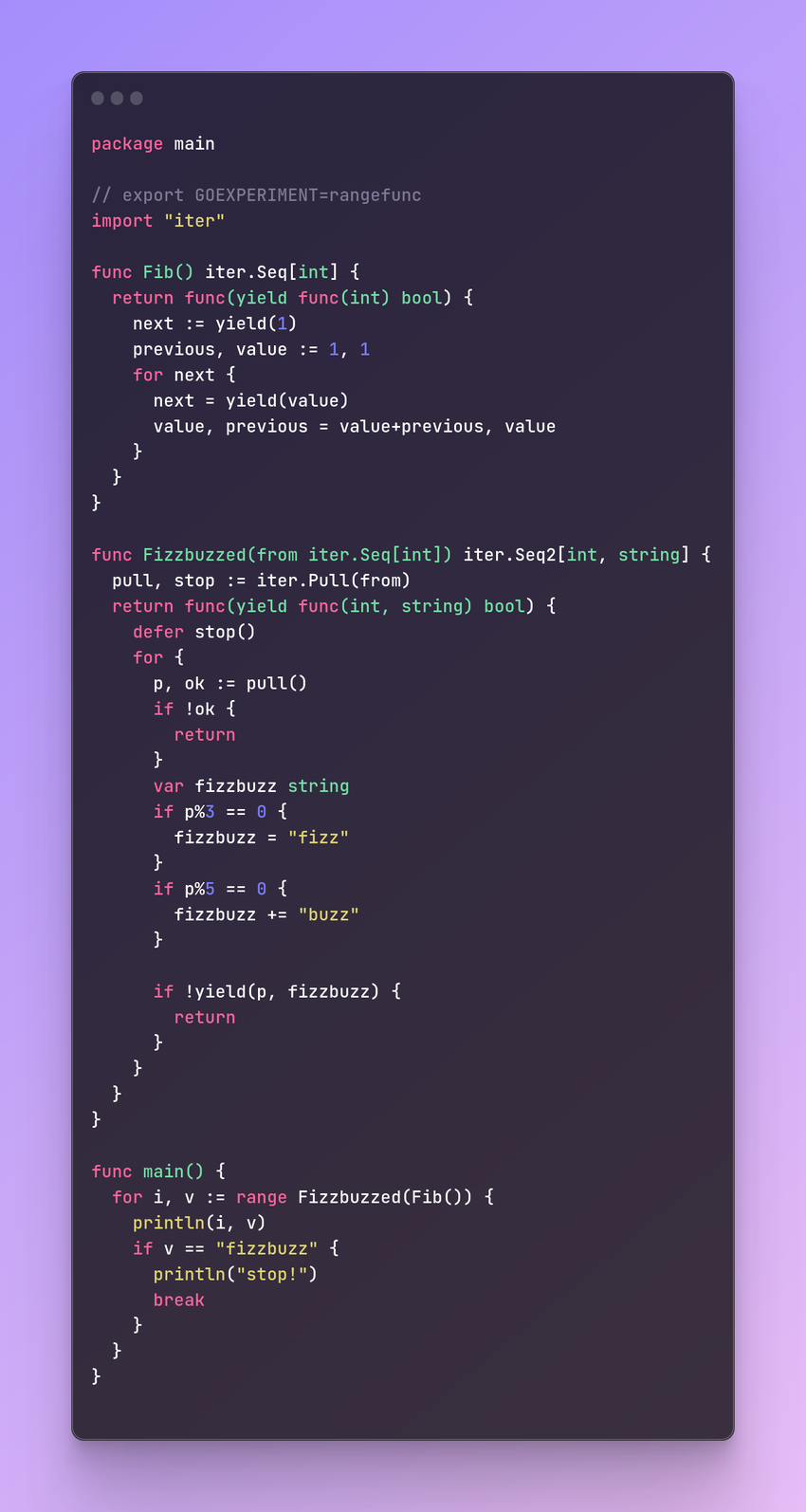
Go 1.22.0 introduces a new experiment for range functions. Have you tried them out? What do you think it can make easier to accomplish?
⤋ Read More
Things can get very interesting when we add the iter.Pull function in the mix. It works like pythons yield from.
↳
In-reply-to
»
Go 1.22.0 introduces a new experiment for range functions. Have you tried them out? What do you think it can make easier to accomplish?
⤋ Read More
Things can get very interesting when we add the iter.Pull function in the mix. It works like pythons yield from.
Build code security skills with the GitHub Secure Code Game
Learn to find and fix security issues while having fun with Secure Code Game, now with new challenges focusing on JavaScript, Python, Go, and GitHub Actions!
The post Build code security skills with the GitHub Secure Code Game appeared first on The GitHub Blog. ⌘ Read more
PEP 742: Narrowing types with TypeNarrower
This PEP proposes a new special form, TypeNarrower, to allow annotating functions that can be used to narrow the type of a value, similar to the builtin isinstance(). Unlike the existing typing.TypeGuard special form, TypeNarrower can narrow the type in both the if and else branches of a conditional. ⌘ Read more
Python Hash Sets Explained & Demonstrated - Computerphile ⌘ Read more
Golang 有必要實現 async-await 嗎?
前言 今天在某站上面看到一個大佬解釋 Golang 中的錯誤處理 err !=nil 時,直接用 Javascript 的 async/await 來解釋。async/await 語法糖在 C#, Python 和 Javascript 中是很常見的異步協程寫法,而在 Golang 中則是使用 goroutine 機制。這時習慣或者喜歡 async/await 語法糖的人可能就會有疑問:Gola ⌘ Read more
PEP 741: Python Configuration C API
Add a C API to the limited C API to configure the Python preinitialization and initialization, and to get the current configuration. It can be used with the stable ABI. ⌘ Read more
Python Regular Expressions - Computerphile ⌘ Read more
PEP 738: Adding Android as a supported platform
This PEP proposes adding Android as a supported platform in CPython. The initial goal is for Android to achieve Tier 3 support in Python 3.13. ⌘ Read more
介紹 Agency: 使 AI 與 Go 語言無縫對接
在當今應用開發領域,類似 OpenAI API 等生成式 AI 技術的蓬勃發展正在徹底改變着應用開發的格局。Python 和 JavaScript 等語言已經擁有豐富的資源來支持這些技術,其中 LangChain 就是一個顯著的例子。然而,Go 語言開發者面臨的選擇卻相對有限。LangChainGo,作爲 LangChain 的 Go 語言版本,一直在努力與 Go 的編程理念保持一致,而 Lang ⌘ Read more
This day one advantage of code was pretty neat looking.
https://twitter.com/gereleth/status/1730495736070938786?s=09
Code here: https://github.com/gereleth/aoc_python/blob/main/src/year2023/day01vis.py