↳
In-reply-to
»
@david SQLite
⤋ Read More
@prologic@twtxt.net that “little database that could” is simply amazing, isn’t it? I run Conduwuit (nevermind, this one is RocksDB), and GoToSocial using it as a backend, no issues. And, of course, sqlite is the database of choice for a lot of things under iOS.
↳
In-reply-to
»
So I'm a location based system, how exactly do I reply to one of these two Twts from @Yarns ? 🤔
⤋ Read More
I demand full 9 digit nano second timestamps and the full TZ identifier as documented in the tz 2024b database! I need to know if there was a change in daylight savings as per the locality in question as of the provided date.
↳
In-reply-to
»
So I'm a location based system, how exactly do I reply to one of these two Twts from @Yarns ? 🤔
⤋ Read More
I demand full 9 digit nano second timestamps and the full TZ identifier as documented in the tz 2024b database! I need to know if there was a change in daylight savings as per the locality in question as of the provided date.
↳
In-reply-to
»
I wrote some code to try out non-hash reply subjects formatted as (replyto ), while keeping the ability to use the existing hash style.
⤋ Read More
BTW this code doesn’t incorporate existing twts into jenny’s database. It’s best used starting from scratch. I’ve been testing it using a custom XDG_CACHE_HOME and XDG_CONFIG_HOME to avoid messing with my “real” jenny data.
I wrote some code to try out non-hash reply subjects formatted as (replyto ), while keeping the ability to use the existing hash style.
I don’t think we need to decide all at once. If clients add support for a new method then people can use it if they like. The downside of course is that this costs developer time, so I decided to invest a few hours of my own time into a proof of concept.
With apologies to @movq@www.uninformativ.de for corrupting jenny’s beautiful code. I don’t write this expecting you to incorporate the patch, because it does complicate things and might not be a direction you want to go in. But if you like any part of this approach feel free to use bits of it; I release the patch under jenny’s current LICENCE.
Supporting both kinds of reply in jenny was complicated because each email can only have one Message-Id, and because it’s possible the target twt will not be seen until after the twt referencing it. The following patch uses an sqlite database to keep track of known (url, timestamp) pairs, as well as a separate table of (url, timestamp) pairs that haven’t been seen yet but are wanted. When one of those “wanted” twts is finally seen, the mail file gets rewritten to include the appropriate In-Reply-To header.
Patch based on jenny commit 73a5ea81.
https://www.falsifian.org/a/oDtr/patch0.txt
Not implemented:
- Composing twts using the (replyto …) format.
- Probably other important things I’m forgetting.
Can I get someone like maybe @xuu@txt.sour.is or @abucci@anthony.buc.ci or even @eldersnake@we.loveprivacy.club – If you have some spare time – to test this yarnd PR that upgrades the Bitcask dependency for its internal database to v2? 🙏
VERY IMPORTANT If you do; Please Please Please backup your yarn.db database first! 😅 Heaven knows I don’t want to be responsible for fucking up a production database here or there 🤣
Hmmmm, I somehow run into an encoding problem where my inserted data end up mangled in the database. But, both SQLite and Go use UTF-8. What’s happening here? :-?
↳
In-reply-to
»
@bender Sorry, trust was the wrong word. Trust as in, you do not have to check with anything or anyone that the hash is valid. You can verify the hash is valid by recomputing the hash from the content of what it points to, etc.
⤋ Read More
@bender@twtxt.net Yes, they do 🤣 Implicitly, or threading would never work at all 😅 Nor lookups 🤣 They are used as keys. Think of them like a primary key in a database or index. I totally get where you’re coming from, but there are trade-offs with using Message/Thread Ids as opposed to Content Addressing (like we do) and I believe we would just encounter other problems by doing so.
My money is on extending the Twt Subject extension to support more (optional) advanced “subjects”; i.e: indicating you edited a Twt you already published in your feed as @falsifian@www.falsifian.org indicated 👌
Then we have a secondary (bure much rarer) problem of the “identity” of a feed in the first place. Using the URL you fetch the feed from as @lyse@lyse.isobeef.org ’s client tt seems to do or using the # url = metadata field as every other client does (according to the spec) is problematic when you decide to change where you host your feed. In fact the spec says:
Users are advised to not change the first one of their urls. If they move their feed to a new URL, they should add this new URL as a new url field.
See Choosing the Feed URL – This is one of our longest debates and challenges, and I think (_I suspect along with @xuu@txt.sour.is _) that the right way to solve this is to use public/private key(s) where you actually have a public key fingerprint as your feed’s unique identity that never changes.
A new uncensored search engine has been launched by enthusiasts, I don’t know if you’ve heard about it or not https://cdg.iounews.com The search engine uses its own database for searching. It works even for me in Windows XP
↳
In-reply-to
»
@lyse so, is it safe to assume you occasionally, but carefully, vet your feeds, and have contingencies in place to not keep requesting a seemingly dead feed over and over?
⤋ Read More
Correct, @bender@twtxt.net. Since the very beginning, my twtxt flow is very flawed. But it turns out to be an advantage for this sort of problem. :-) I still use the official (but patched) twtxt client by buckket to actually fetch and fill the cache. I think one of of the patches played around with the error reporting. This way, any problems with fetching or parsing feeds show up immediately. Once I think, I’ve seen enough errors, I unsubscribe.
tt is just a viewer into the cache. The read statuses are stored in a separate database file.
It also happened a few times, that I thought some feed was permanently dead and removed it from my list. But then, others mentioned it, so I resubscribed.
你是如何用 Go 語言 配置高性能 sql-DB 的?
配置高性能的 sql.DB 是 Go 應用程序開發中一個重要的環節,特別是在需要處理大量數據庫查詢的情況下。以下是一些最佳實踐和配置建議:1. 數據庫連接池的配置Go 的 database/sql 包提供了連接池的功能,您可以通過設置最大空閒連接、最大打開連接數和連接的最大生命週期來優化連接池。db, err := sql.Open(“mysql”, ”user:password@tcp(127. ⌘ Read more
It took me so long to find the cause of a memory leak in GoBlog. I thought it was smart to use a cache for prepared database statements. But I didn’t read the documentation and didn’t know that prepared statements need to be closed when they are no longer needed to free up the allocated resources. 🤦♂️ I finally fixed it by removing the prepared statement cache altogether. Less code, fewer problems in the future, and the cache wasn’t much of an improvement anyway. I also learned about the usefulness of memory profil … ⌘ Read more
Authy Users Urged to Stay Alert After Hack Exposes 33 Million Phone Numbers
Twilio has updated its Authy two-factor authentication (2FA) service after a hacker claimed to have retrieved 33 million phone numbers from its user database.
TechCrunch reports that the hacker(s) known as ShinyHunters took to a well-kn … ⌘ Read more
Celebrating 10 years of Kubernetes: the evolution of database operators
Member post originally published on Since its launch in June 2014, Kubernetes has revolutionized container orchestration, transforming how applications are managed and scaled. The Data on Kubernetes Community (DoKC) created an infographic to celebrate Kubernetes’ tenth anniversary and… ⌘ Read more
Erlang Solutions: Let Your Database Update You with EctoWatch
Elixir allows application developers to create very parallel and very complex systems. Tools like Phoenix PubSub and LiveView thrive on this property of the language, making it very easy to develop functionality that requires continuous updates to users and clients.
But one thing that has often frustrated me is how to cleanly design an application to respond to database record updates.
A typical pattern that I’ve used is t … ⌘ Read more
Haha, yeah sorry about that, I wasn’t even trying to nuke the database either but it worked out that way 😩
@prologic@twtxt.net Righteo, so rookie error - I obviously had some untracked, rather important files for starting my pod and I ran a make clean. Why I originally had them in the git directory is anyone’s guess. Anyway it blew away those files including the database so that’s that. So your good self and @bender@twtxt.net etc - apologies but your profiles got nuked as well (as did my own but easily recreated).
Another thing I noticed which was the reason I ran make clean in the first place. I noticed my pod was being built with Go 1.22.4. Could this be a problem @prologic? preflight.sh actually errors out about it…
Gajim: Gajim 1.9.0
Half a year after the last release, Gajim 1.9.0 is finally here. 🎉 This release brings long awaited support for message replies and message reactions. Message Moderation has been improved as well. Say hello to voice messages! Thank you for all your contributions!
It took us quite some time, but now it’s here: Gajim 1.9 comes with a complete database overhaul, which enables new features such as Message Replies and Message Reactions.
Message Replies ( [XEP-0461: Message Repl … ⌘ Read more
Four’N Twenty owner Patties Foods hit by data leak, investigating source of breach
Thousands of documents, including invoices, orders and banking information of the parent company of a handful of major food brands were leaked online via an unprotected database. ⌘ Read more
Gorm 源碼解析
我們先通過一張圖來看 Gorm 核心主流程。gorm 主流程1. 初始化 DB 連接—————-使用 database.sql 初始化連接。我們平時所說的數據庫驅動其實就是每個數據庫對 DSN 不同的解析方式,最終底層都是使用的 TCP 建立起數據庫連接。type Connector interface { Connect(context.Context) (Conn, err ⌘ Read more
New Beats Pill Appears in FCC Database Ahead of Launch
Multiple celebrities have been spotted with a new version of the Beats Pill speaker, and today the device showed up in an FCC database, suggesting that we’re getting closer to a potential launch.
FCC filings typically happen just weeks ahead of when a product launches, so we could see this new Beats Pill speaker sometime in June. Apple plans to launch [Solo Buds … ⌘ Read more
Erlang Solutions: Instant Scalability with MongooseIM and CETS
The main feature of the recently released MongooseIM 6.2.1 is the improved CETS in-memory storage backend which makes it much easier to scale up.
It is difficult to predict how much traffic your XMPP server will need to handle. Are you going to have thousands or millions of connected users? … ⌘ Read more
sqlx: 功能強大的數據庫訪問庫
sqlx[1] 是一個用於擴展標準庫 database/sql 的庫,它提供了一些額外的功能,使得在 Go 中使用 sql 更加方便。sqlx 的目標是保持 database/sql 的簡單性,同時提供更多的功能。sqlx 爲 Go 的標準 database/sql 庫提供了一組擴展。sqlx 中的 sql.Conn、sql.DB、sql.TX、sql.Stmt、sql.Rows、sql.Row ⌘ Read more
ProcessOne: ejabberd 23.04
This new ejabberd 23.04 release includes many improvements and bug fixes, as well as some new features.
- Many SQL database improvements
mod_mamsupport for XEP-0425: Message Moderation
- New
mod_muc_rtbl, Real-Time Block List for MUC rooms
- Binaries useErlang/OTP 25.3, and changes in containers
A more detailed explanatio … ⌘ Read more
ProcessOne: Automatic schema update in ejabberd
ejabberd 23.10 has a new feature that is currently in beta testing:
Automatic relational schema creation and update.
Previously, if you were using ejabberd with an external relational database, you might have to manually apply some schema changes that come with new features when you upgrade to a new ejabberd release. ejabberd can now handle this schema upgrade automat … ⌘ Read more
Go 配置文件大揭祕:INI 文件讀寫實戰詳解
*1. INI 文件簡介INI(Initialization)文件是一種簡單、文本文件格式,常用於配置文件。它由多個節(section)組成,每個節包含多個鍵值對。鍵值對的格式爲 key=value,節的格式爲 [section]。簡單示例如下:// 示例INI文件[database]host = localhostport = 3306username = userpassword = sec ⌘ Read more
ProcessOne: Automatic schema update in ejabberd
ejabberd 23.10 has a new feature that is currently in beta testing:
Automatic relational schema creation and update.
Previously, if you were using ejabberd with an external relational database, you might have to manually apply some schema changes that come with new features when you upgrade to a new ejabberd release. ejabberd can now handle this schema upgrade automat … ⌘ Read more
Thinking of building a simple “Things our kids say” database form, using Node, Express and SQlite3. Going beyond simple text files.
ProcessOne: Automatic schema update in ejabberd
ejabberd 23.10 has a new feature that is currently in beta testing:
Automatic relational schema creation and update.
Previously, if you were using ejabberd with an external relational database, you might have to manually apply some schema changes that come with new features when you upgrade to a new ejabberd release. ejabberd can now handle this schema upgrade automat … ⌘ Read more
How to Get Started with the Weaviate Vector Database on Docker
With Weaviate, you can build advanced LLM applications, next-level search systems, recommendation systems, and more. Discover features of the Weaviate vector database and learn how to install Weaviate on Docker using Docker Compose. ⌘ Read more
Memgraph Docker Extension: Empowering Real-Time Analytics with High Performance
Learn how using Memgraph as a Docker Extension offers a powerful and efficient way to leverage real-time analytics from a graph database. ⌘ Read more
ProcessOne: ejabberd 23.04
This new ejabberd 23.04 release includes many improvements and bug fixes, as well as some new features.
- Many SQL database improvements
mod_mamsupport for XEP-0425: Message Moderation
- New
mod_muc_rtbl, Real-Time Block List for MUC rooms
- Binaries useErlang/OTP 25.3, and changes in containers
A more detailed explanatio … ⌘ Read more
ProcessOne: ejabberd 23.04
This new ejabberd 23.04 release includes many improvements and bug fixes, as well as some new features.
- Many SQL database improvements
mod_mamsupport for XEP-0425: Message Moderation
- New
mod_muc_rtbl, Real-Time Block List for MUC rooms
- Binaries useErlang/OTP 25.3, and changes in containers
A more detailed explanatio … ⌘ Read more
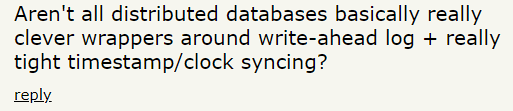
From my small experience in writing an event database, I am inclined to agree with this.
From my small experience in writing an event database, I am inclined to agree with this.
Kev built his own microblog using WordPress and iOS shortcuts to separate his long and short posts. It sounds like this is a better alternative for him than micro.blog. Maybe with SQLite as the database he can even simplify this setup. ⌘ Read more
If you’re looking for a cool p2p database system have a look at www.earthstar-project.org
Distributed Cloud-Native Graph Database with NebulaGraph Docker Extension
Let’s take a look at NebulaGraph and how this modern, open source database can help your organization store and query complex data relationships. ⌘ Read more
↳
In-reply-to
»
@lyse flawed is the right word, no harsh at all. Good reading, and thanks for supporting the possibility of convincing @prologic to switch to a database! :-D :-P
⤋ Read More
@abucci@anthony.buc.ci Where did I hate on SQL databases? 🤔
↳
In-reply-to
»
@eldersnake Several reasons:
⤋ Read More
@lyse@lyse.isobeef.org flawed is the right word, no harsh at all. Good reading, and thanks for supporting the possibility of convincing @prologic@twtxt.net to switch to a database! :-D :-P
↳
In-reply-to
»
I've never liked the idea of having everything displayed all of the time for all of history.
⤋ Read More
@eldersnake@we.loveprivacy.club Several reasons:
- It’s another language to learn (SQL)
- It adds another dependency to your system
- It’s another failure mode (database blows up, scheme changes, indexs, etc)
- It increases security problems (now you have to worry about being SQL-safe)
And most of all, in my experience, it doesn’t actually solve any problems that a good key/value store can solve with good indexes and good data structures. I’m just no longer a fan, I used to use MySQL, SQLite, etc back in the day, these days, nope I wouldn’t even go anywhere near a database (for my own projects) if I can help it – It’s just another thing that can fail, another operational overhead.
The CIA invests in these Tech companies
Video games. Search engines. Social Media. Open Source. Even SQL databases. Seriously. ⌘ Read more
Erlang Solutions: Change data capture with Postgres & Elixir
CDC is the process of identifying and capturing data changes from the database.
With CDC, changes to data can be tracked in near real-time, and that information can be used to support a variety of use cases, including auditing, replication, and synchronisation.
A good example of a use case for CDC is to consider an application which inserts a record into the database and pushes an event to a message queue after the record has … ⌘ Read more
RT by @mind_booster: The EU will fund a pilot project for a public directory of #publicdomain works. This is based on a whitepaper I wrote with @Senficon for the 2021 @creativecommons summit. Thanks for bringing us 1 step closer to making this a reality @echo_pbreyer & team! https://www.patrick-breyer.de/en/kick-off-for-eu-database-of-public-domain-works-and-digital-access-to-scientific-works/
The EU will fund a pilot project for a public directory of [#publicdomain](https://nitter.net/search?q=%23publicdom … ⌘ Read more
Why and how GitHub encrypts sensitive database columns using ActiveRecord::Encryption
You may know that GitHub encrypts your source code at rest, but you may not have known that we encrypt sensitive database columns as well. Read about our column encryption strategy and our decision to adopt the Rails column encryption standard. ⌘ Read more
Containerizing a Slack Clone App Built with the MERN Stack
The MERN Stack is a fast growing, open source JavaScript stack that’s gained huge momentum among today’s web developers. MERN is a diverse collection of robust technologies (namely, Mongo, Express, React, and Node) for developing scalable web applications — supported by frontend, backend, and database components. Node, Express, and React even ranked highly among most-popular […] ⌘ Read more
Git’s database internals V: scalability
This fifth and final part of our blog series exploring Git’s internals shows several strategies for scaling your Git repositories that match related database sharding techniques. ⌘ Read more
Git’s database internals IV: distributed synchronization
We’re examining Git’s internals to help make your engineering system more efficient. This post views Git as a distributed database and looks into its synchronization techniques, specifically ‘git fetch’ and ‘git push’. ⌘ Read more
Git’s Database Internals III: File History Queries
Git’s file history queries use specialized algorithms that are tailored to common developer behavior. Level up your history spelunking skills by learning how different history modes behave and which ones to use when you need them. ⌘ Read more
Git’s database internals II: commit history queries
This post explores Git commit history as a database where ‘git log’ is the query language. Learn about Git’s custom query index – the commit-graph file – and how to make sure it’s enabled in your repositories. ⌘ Read more
Git’s database internals I: packed object store
This blog series will examine Git’s internals to help make your engineering system more efficient. Part I discusses how Git stores its data in packfiles using custom compression techniques. ⌘ Read more
Introducing Trilogy: a new database adapter for Ruby on Rails
We’ve open sourced Trilogy, the database adapter we use to connect Ruby on Rails to MySQL-compatible database servers. ⌘ Read more
Dino: Stateless File Sharing: Sources and Compatibility
This is my next progress post about my Google Summer of Code project of implementing Stateless File Sharing (sfs)
Like everything else we receive, we need to store the sfs sources in a database.
In this case, we are in a unique position:
Not only are there different kinds of sources, but even http sources on their own are not trivial.
For now, we only … ⌘ Read more
Hi, I am playing with making an event sourcing database. Its super alpha but I thought I would share since others are talking about databases and such.
It’s super basic. Using tidwall/wal as the disk backing. The first use case I am playing with is an implementation of msgbus. I can post events to it and read them back in reverse order.
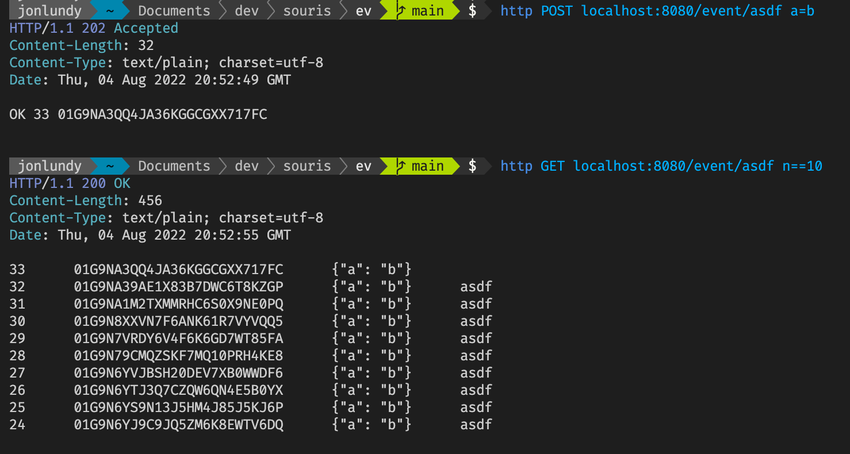
I plan to expand it to handle other event sourcing type things like aggregates and projections.
Find it here: sour-is/ev
@prologic@twtxt.net @movq@www.uninformativ.de @lyse@lyse.isobeef.org
Hi, I am playing with making an event sourcing database. Its super alpha but I thought I would share since others are talking about databases and such.
It’s super basic. Using tidwall/wal as the disk backing. The first use case I am playing with is an implementation of msgbus. I can post events to it and read them back in reverse order.
I plan to expand it to handle other event sourcing type things like aggregates and projections.
Find it here: sour-is/ev
@prologic@twtxt.net @movq@www.uninformativ.de @lyse@lyse.isobeef.org
So far I configured most (almost all) settings for GoBlog through a YAML file. But this is not so optimal, after all it happens sometimes that I want to change a small setting, such as the description of a post section, from my smartphone. This would work somehow via SSH, but ideal is something else. Email conversations with Andrés Cárdenas inspired me to finally start the project “settings in the database”. The first step was to make it possible to configure the mentioned post sections. This is now finally possible … ⌘ Read more
GitHub Advisory Database now supports Erlang and Elixir packages!
We’re excited to announce that the GitHub Advisory Database now includes curated security advisories on Erlang, Elixir, and more. ⌘ Read more
China’s internet watchdog launches cybersecurity investigation into country’s largest academic research database CNKI
It marks the Cyberspace Administration of China’s first investigation since the new regulation on cybersecurity review measures took effect in February this year. ⌘ Read more
GitHub now publishes malware advisories in the GitHub Advisory Database
To combat the prevalence of malware in the open source ecosystem, GitHub now publishes malware occurrences in the GitHub Advisory Database. These advisories power Dependabot alerts and remain forever free and usable by the community. ⌘ Read more
“Common Table Expressions in SQL”
I’m currently working in a project that involves a lot of data processing and therefore databases. This means that we often come into contact with SQL at work and have to write an SQL query at least once a day. ⌘ Read more
“Friendlier SQL with DuckDB”
I come into contact with SQL almost every day, be it at work (Oracle Database) or while developing my blog software (SQLite). I don’t find SQL as bad as some others might, but sometimes SQL could be better. ⌘ Read more
ProcessOne: ejabberd 21.12
This new ejabberd 21.12 release comes after five months of work, contains more than one hundred changes, many of them are major improvements or features, and several bug fixes.
When upgrading from previous versions, please notice: there’s a change in mod_register_web behaviour, and PosgreSQL database, please take a look if they affect your installation.
A more detailed explanation of those … ⌘ Read more
An update on recent service disruptions
Over the past few weeks, we have experienced multiple incidents due to the health of our database. We wanted to share what we know about these incidents while our team continues to address them. ⌘ Read more
** 2022-02-24 feature/6.0 Android test plan **
OverviewWill test the upgrade path from a known state to new version to ensure that settings and app state are maintained during upgrade process.
V. 6.0 of libro.fm android app introduces an entirely new local database. This testing is focused on ensuring that local data remains intact between versions.
NotesThis evening I was mostly focused on setting up a successful build of feature/6.0 on my test device or the emulator. So far, no dice. My next … ⌘ Read more
What a good feeling when the hours you have invested in optimizing and testing actually bear fruit. In other words, my blog now uses less than 100 MB of memory, even though I have quite a few features enabled. My diary for example needs less than 20 MB. And if you compare that with WordPress, where the database alone needs more than 300 MB… 😄 ⌘ Read more
GitHub Advisory Database now open to community contributions
Anyone can now provide additional information to further the community’s understanding and awareness of security advisories. ⌘ Read more
Ignite Realtime Blog: Openfire 4.7.1 Released!
The Ignite Realtime Community is happy to announce the 4.7.1 release of Openfire. This release fixes a number of bugs and represents our effort to provide a stable 4.7.x series while work continues on the next feature release of Openfire.
Notable fixes include security updates to bundled database drivers, logging configuration fixes, and an important fix for users experiencin … ⌘ Read more
Code scanning and Ruby: turning source code into a queryable database
A deep dive into how GitHub adds support for new languages to CodeQL. ⌘ Read more
Thinking beyond SQL injection: OWASP tips for secure database access
When it comes to secure database access, there’s more to consider than SQL injections. OWASP Top 10 Proactive Control C3 offers guidance. ⌘ Read more
How Docker Desktop Networking Works Under the Hood
Modern applications make extensive use of networks. At build time it’s common to apt-get/dnf/yum/apk install a package from a Linux distribution’s package repository. At runtime an application may wish to connect() to an internal postgres or mysql database to persist some state, while also calling listen() and accept() to expose APIs and UIs over TCP […]
The post [How Docker Desktop Networking Works Under the Hood](https://www.docker.com … ⌘ Read more
Video: C Programming on System 6 - A New On-Disk Database Format
It’s a new year and my computer is still old. ⌘ Read more
“Consider SQLite”
I am convinced of SQLite. For many use cases where other databases like MySQL, MariaDB or PostgreSQL are often used, SQLite would suffice, given the right design and architecture. ⌘ Read more
ProcessOne: ejabberd 21.12
This new ejabberd 21.12 release comes after five months of work, contains more than one hundred changes, many of them are major improvements or features, and several bug fixes.
When upgrading from previous versions, please notice: there’s a change in mod_register_web behaviour, and PosgreSQL database, please take a look if they affect your installation.
A more detailed expla … ⌘ Read more
ProcessOne: ejabberd 21.12
This new ejabberd 21.12 release comes after five months of work, contains more than one hundred changes, many of them are major improvements or features, and several bug fixes.
When upgrading from previous versions, please notice: there’s a change in mod_register_web behaviour, and PosgreSQL database, please take a look if they affect your installation.
A more detailed expla … ⌘ Read more
ProcessOne: ejabberd 21.12
This new ejabberd 21.12 release comes after five months of work, contains more than one hundred changes, many of them are major improvements or features, and several bug fixes.
When upgrading from previous versions, please notice: there’s a change in mod_register_web behaviour, and PosgreSQL database, please take a look if they affect your installation.
A more detailed expla … ⌘ Read more
↳
In-reply-to
»
Web3 is a scam. Case in point. The complexity of systems increasing the points of failure. From this article.
⤋ Read More
The complexity is a feature. It means standards can be replaced with products that let providers get their cut. It means putting data into the slowest most expensive database in cost and enviromnmental impact.
↳
In-reply-to
»
Web3 is a scam. Case in point. The complexity of systems increasing the points of failure. From this article.
⤋ Read More
The complexity is a feature. It means standards can be replaced with products that let providers get their cut. It means putting data into the slowest most expensive database in cost and enviromnmental impact.
I will never understand this obsession with “scaling”. Modern web dev seriously over-complicates so many things, it’s not even funny anymore. How we built a serverless SQL database | Hacker News
GitHub Advisory Database now powers npm audit
Today, we’re adding a proxy on top of the GitHub Advisory Database that speaks the `npm audit` protocol. This means that every version of the npm CLI that supports security audits is now talking directly to the GitHub Advisory Database. ⌘ Read more
Partitioning GitHub’s relational databases to handle scale
In 2019, to meet GitHub’s growth and availability challenges, we set a plan in motion to improve our tooling and ability to partition relational databases. ⌘ Read more
GitHub Advisory Database now supports Rust
We’re excited to announce that the GitHub Advisory Database now includes curated security advisories on the Rust ecosystem! ⌘ Read more
↳
In-reply-to
»
[20:22:00] -tower.freenode.net- Server Terminating. Received SIGTERM
⤋ Read More
You’ve basically already left, whether you know it or not. Yesterday they nuked their services database. I’d been there ~20 years, but it’s dead. Libera.chat has been lovely.
Think of it like buying a signed print of a photo, instead of the photo itself, but the “signature” is an entry in a database and that’s all you get. Still dumb.
The lospec palette list is a database of palettes for pixel art: [[https://lospec.com/palette-list]] #links #pixelart #color
huh. it seems that dumping + gzipping a SQLite database can sometimes have better compression than gzipping the SQLite database directly. cool. #sqlite
It works better if you start up its database first.
Baserow: Open source online database tool https://gitlab.com/bramw/baserow #airtable alternative ⌘ https://baserow.io/
here is the script I use to convert my twtxt feed into a SQLite database: !twtxt_sqlite
a unique thing I do with my twtxt feed is convert it to a SQLite database. This, combined with the Janet + SQLite scripting abilities available in SQLite, could provide interesting metrics and insights over time.
in particular, twtxt provides timestamps. weewiki doesn’t really track the passage of time. it only wants to be a key/value database with org markup.
Posted to Entropy Arbitrage: Database Basics https://john.colagioia.net/blog/2020/04/05/database.html #database #intro #education #preparation
I loved coding ToH, I want to write more database-less websites/services
How Does a Database Work? | Let’s Build a Simple Database https://cstack.github.io/db_tutorial/
Database as Filesystem - YouTube https://www.youtube.com/watch?v=wN6IwNriwHc
Setup Syncthing to mirror buku bookmark database
Notion “ The all-in-one workspace for your notes, tasks, wikis, and databases. https://www.notion.so/tools-and-craft/03-ted-nelson
Interesting idea: create a search-by-meaning for functions using the memoization database http://www.vpri.org/pdf/rn2017002_memoization.pdf
GitHub - orbitdb/orbit-db: Peer-to-Peer Databases for the Decentralized Web https://github.com/orbitdb/orbit-db