↳
In-reply-to
»
I was Today years old when I learned about the
⤋ Read More
Compose Key 🫠 So, no more Ctrl+Shift+U's for or having to remember Unicode like a chimp
@movq@www.uninformativ.de It is such a relief !! I can finally type my Ç, œ, à, ê, é …etc without breaking a sweat. xD
↳
In-reply-to
»
I was Today years old when I learned about the
⤋ Read More
Compose Key 🫠 So, no more Ctrl+Shift+U's for or having to remember Unicode like a chimp
@aelaraji@aelaraji.com I love the Compose Key. 😃 Want that “o” with the slash in it? Type Compose + o + / and there you go: ø. I use it all the time. Also for stuff like → arrows or ™.
@movq@www.uninformativ.de Right now I am using my ai coded twtxt api to edit the twtxt.txt file directly with the api. As well as my ai coded twtxt desktop and mobile clients to go with it. Though the code at least for the desktop client is just a single python file. Plus I do know in the future it might be unmaintable.
I am not the type of person to be like “wow do everything in ai this is so great”
The entire reason I tried ai coding a twtxt client was because in an irc channel someone was like “twtxt is so simple even ai can do it” and then I get a five year old (the ai) to do it and because its simple its actually done. I don’t excpect it to be the best ever compared to the human coded twtxt stuff but at least it gets me back on twtxt. I don’t like every other twtxt client that much.
↳
In-reply-to
»
Finally got Thunder & Rain! Woooho ⚡👯⚡
⤋ Read More
@zyak@twtxt.z85b.xyz yeah, I totally get it. Especially after the insane type of weather we’ve been getting lately… but hey, soak in as much sunlight while you still can, we might start longing for that instead of storm and rain in a couple of months from now 😆
I think it is safe to argue that a lot of #Python’s success is derived from it being adopted early by end-user programmers, both in and out of the broad scientific community. We got the numeric computation infrastructure, then astronomers, computational linguistics folks, computer vision buffs, pioneering data journalists, the type design crew (Guido’s brother, wink wink), the list goes on and on.
If I were a retired person with time and money to spare I would start a “Python scientific and end-user programmers association” to advocate for the interests of people who use Python not as professional developers. We could fund a well designed “Python census” that would probably show we are more numerous than the professional developers (instead of the stupid JetBrains survey). Also, I hope we wouldn’t be funded by big corps and would be able to criticize them freely.
@david@daiwei.me if you have some weekend home type place, with no Internet, getting TV through an antenna and a DVBT box, my recommendation is to just buy some old Dell monitor with HDMI to 3.5mm audio output built in, so you can connect speakers to it.
Doesn’t have to be Dell, but you can often just buy one of those from your employer, for under $25 here.
Were this sadly makes much less sense, in with Internet TV services. Those usually need a dedicated TV app to function and while that can be replaced with a $200 TV box, that some providers force you to rent, thus making you pay more for your Internet TV forever - this also means giving up the “archive app”, that gives you access to all the on demand content, included in the price of your mandatory TV license. None of these overpriced boxes come with it, as they’d mauch rather make you pay, for yet another subscription service instead.
So yes, you can kinda do it with an Internet TV too, assuming you trust the expensive box to not spy on you, but in that case you’re mostly just paying a whole lot more, for a lot less, than you would be, with the LG TV.
↳
In-reply-to
»
Why.
⤋ Read More
@movq@www.uninformativ.de Type hints are just… so weird.
Why.
Python’s numeric types complex, float and int are not subtypes of each other, but to support common use cases, the type system contains a straightforward shortcut: when an argument is annotated as having type float, an argument of type int is acceptable; similar, for an argument annotated as having type complex, arguments of type float or int are acceptable.
https://typing.python.org/en/latest/spec/special-types.html#special-cases-for-float-and-complex
@david@daiwei.me Oh, really? I thought I’ve posted compose view screenshots before. Anyway. Glad you like it as much as I do. :-)
The update interval has always been one second. I just didn’t remember and thus tried to time it by watching the preview update while typing. It felt like roughly under two seconds, but apparently my inner clock was off. After taking the screenshot and then examining it more closely, I noticed that the interval is stated right in the UI. :-D So, I just amended my message and didn’t bother taking a new screenshot. I figured I just leave it alone and see who spots the change, if at all. And, of course, you found the easter egg. Congrats, mate! 8-)
I really think I should go back to Java.
Writing programs in Python is so exhausting. I want a compiler and I want static typing. No, linters and type checkers and IDEs are not good enough. Compilers catch way more errors in advance.
Rust is also exhausting. They’re constantly adding language features and, at the same time, the runtime library remains tiny and you need 3rd party libraries for everything. Many of those are still at version 0.x (SemVer!) and you can’t rely on anything. Often times, you need the latest Rust nightly compiler.
Go is … I don’t like it. And huge binaries.
I like C as a language, but it’s too fragile. I want to have a proper HashMap every now and then.
None of the above have good GUI libraries, at least not on Linux.
And then there’s Java. This is my fractal renderer that I wrote over 17 years ago:
https://movq.de/v/fcd3c4e557/vid-1784121825.mp4
It’s fast. It has a GUI with custom widgets and those weren’t even hard to make. It still works without changing a single line of code. The source code files have timestamps from 2009 and I just noticed that the JAR file I’m using in the video was compiled in 2010.
Java as a language is relatively easy to learn and to master. There are few surprises. The source code organization with packages is good. Java API docs are clear and well written.
The JVM ramp-up times have improved considerably:
https://movq.de/v/e7314e521e/vid-1784121998.mp4
This isn’t like the Dark Ages anymore. Might even be usable for some CLI tools.
The only thing where Java really sucks is anything close-ish to the kernel. Try issuing an ioctl() … I couldn’t have made my TUI framework in Java, but then again, I wouldn’t have needed to because Swing already exists and it just works.
Hurray, I can now press gg instead of g to go to the top in tt. Much better! :-) Other multi-key combinations are also easily possible now.
I should probably write a real article about this at some point, but here we go. The only downside with my new key binding system is that it breaks tview’s established pattern. You’ve got an InputHandler(), that is implemented using WrapInputHandler(…). It typically then directly implements the switching logic depending on the key press. Something like this:
func (w *Widget) InputHandler() func(event *tcell.EventKey, setFocus func(p tview.Primitive)) {
    // WrapInputHandler allows for intercepting key events with SetInputCapture(…)
    // from the outside for customization. This handles the default key bindings.
    return t.WrapInputHandler(func(event *tcell.EventKey, setFocus func(p tview.Primitive)) {
        switch event.Key() {
        case tcell.KeyRune:
            if event.Modifiers() == tcell.ModNone {
                switch event.Rune() {
                case 'k':
                    w.scrollUp()
                    return // we already handled the event, stop processing

                case 'j':
                    w.scrollDown()
                    return
                }
            }
        }

        // We didn't handle the key event. Maybe the parent
        // widget knows what to do with it.
        if handler := w.parent.InputHandler(); handler != nil {
            handler(event, setFocus)
        }
    })
}
From the outside, you can intercept and either stop or continue the widget’s original key handling with a potentially rewritten key event using SetInputCapture(…):
w := NewWidget()
// customized or additional key bindings
w.SetInputCapture(func(event *tcell.EventKey) *tcell.EventKey {
    switch event.Key() {
    case tcell.KeyUp:
        // Rewrite the event, so the "cursor up" key is an alias
        // for the vim key binding "k", that is handled by the
        // wrapped input handler above. (I know, I know, this is a
        // completely unrealistic example, why would anyone use
        // cursor keys when there are vim key bindings available?!)
        return tcell.NewEventKey(tcell.KeyRune, 'k', tcell.ModNone)

    case tcell.KeyRune:
        if event.Modifiers() == tcell.ModNone {
            switch event.Rune() {
                case 'q':
                    app.Stop()
                    // we already handled the event, do not pass it
                    // to the wrapped input handler above
                    return nil

                case 'r':
                    toggleMessageReadStatus()
                    return nil
            }
        }
    }

    // we didn't handle the event, pass it to the wrapped
    // input handler above
    return event
}
Since they all expect a single key, I’ve noticed that using multiple dedicated KeyBindings of mine on these different levels kinda breaks multi-key handling with common prefixes. The outer-most KeyBinding captures the prefix, but it can’t transfer it to the inner one if not handled by the outer one. At least not without some more (potentially ugly) changes. So, I now have to work with just a single KeyBindings object for the entire widget chain (if it consists of multiple other widgets or the regular input handler and input capture are in the game). The outside needs to register all its key bind customizations or extensions at the same level that the original widget handles its default ones. Doable by exposing the widget’s KeyBindings instance, but not pretty. You always have to keep this in mind.
With the KeyBindings, it will look like that:
type Widget struct {
    parent tview.Primitive

    // make it available to children or the outside either by
    // direct field access or by providing a getter method
    KeyBindings *bind.KeyBindings
}

func NewWidget() *Widget {
    w := &Widget{KeyBindings: &bind.KeyBindings{}}
    w.KeyBindings. // default key bindings
        Bind0(bind.KeySequence('k', w.scrollUp).
        Bind0(bind.KeySequence('j', w.scrollDown)
    return w
}

func (w *Widget) InputHandler() InputHandler() func(event *tcell.EventKey, setFocus func(p tview.Primitive)) {
    return t.WrapInputHandler(func(event *tcell.EventKey, setFocus func(p tview.Primitive)) {
        // also note the missing support for focus transfer at the moment
        event = w.KeyBindings.Capture(event)
        if event == nil {
            return
        }

        if handler := w.parent.InputHandler(); handler != nil {
            handler(event, setFocus)
        }
    }
}
And then from the outside, or in a child widget:
w := NewWidget()
w.KeyBindings. // additional or customized key bindings
    Bind1(bind.KeySequence(tcell.KeyUp), func(*tcell.EventKey) *tcell.EventKey {
        return tcell.NewEventKey(tcell.KeyRune, 'k', tcell.ModNone)
    }).
    Bind0(bind.KeySequence('q'), app.Stop).
    Bind0(bind.KeySequence('r'), toggleMessageReadStatus)
When directly working with tview primitives that are not part of custom widget implementations, the following works well so far:
textView := tview.NewTextView().
    SetWordWrap(true).
    SetText("…")
    SetScrollable(true)
textView.SetInputCapture((&bind.KeyBindings{}).
    Bind0(bind.KeySequence('q'), app.Stop).
    Bind1(bind.KeySequence('g', 'g'), func(*tcell.EventKey) *tcell.EventKey {
        return tcell.NewEventKey(tcell.KeyHome, 0, tcell.ModNone)
    }).
    Capture)
I need to sleep on this some more.
Also, writing very long messages like this one is really not all that fun in tt’s editor. I should absolutely provide a way to shell out to vim.
(Took me about one and a half hours to compose, holy crap. But not only because of not using vim. Although, that might have saved me a quarter hour or so for sure. Proof-reading this message also uncovered quite a few bugs in my real documentation. So, that’s a big win!) Good night!
@GabesArcade@gabesarcade.com The no-JS part is one thing, but you also have to disable the (nowadays common) forced-HTTP-to-HTTPS-redirect, because those old browsers can’t do modern crypto. And make sure that your webserver serves the correct page even if no Host header is sent by the client. And don’t even think about serving UTF-8 or even just putting utf-8 in the content type. 😅 And for the JPEG thumbnails I pass a special flag to ImageMagick so that IBM Web Explorer from OS/2 won’t trip. 🤣 And always use link rel="stylesheet" for CSS, because some browsers render inlined CSS as literal text. And … probably more that I forgot by now. 😂
@david@daiwei.me Not sure, actually. Let’s see. Those are the ones where I still have the original disks (or have bought them on eBay again):
- SuSE Linux 6.4 (it’s a massive 7 CD distro with a huge manual, best thing ever)
- OS/2 2.1
- OS/2 Warp 3 (red and blue spine because
$reasons)
- OS/2 Warp 4
- PC DOS 7
- MS-DOS 6.22
- Windows 3.1
- Windows for Workgroups 3.11
- Windows 95 C
- Windows 98
- Windows NT 4 Workstation (still in the mail, though 😅)
- Windows 2000
- Windows XP Professional (last Windows I ever used on my private PCs)
(Plus a few “classic” office products as can be seen here: https://movq.de/blog/postings/2024-05-23/0/POSTING-en.html )
↳
In-reply-to
»
@lyse Ah, yes, you live in “the zone”: https://social.bund.de/@DeutscherWetterdienst/116839789079697685
⤋ Read More
@movq@www.uninformativ.de Yeah. The thunderstorm was supposed to hit us, sneak north and south around us, directly pay us a vistit again, miss us to the north, directly hit us, and now it’s back to a northern diversion. The thunder heavily roars in the distance at the moment. It’s down to just 10 liters. A mate just got a wet laundry, though, and had to mob up a – luckily – just tiny flood.
As I type, the first drops begin to fall.
Elixir v1.20 released: now a gradually typed language
Article URL: https://elixir-lang.org/blog/2026/06/03/elixir-v1-20-0-released/
Comments URL: https://news.ycombinator.com/item?id=48388324
Points: 79
# Comments: 14 ⌘ Read more
↳
In-reply-to
»
@lyse By the way, which site generator are you using? I kind of miss having code blocks with syntax highlighting and that generic yellow highlighting thing is pretty cool, too.
⤋ Read More
@movq@www.uninformativ.de It’s the “Lyse types the entire HTML by hand” generator. Yes, no kidding. I write articles so rarely, that I can do that once in a while. It’s fun to some degree, but also not.
After some time, I finally recorded some Vim macros to insert <b>…</b>, <var>…</var>, <span class=s>…</span> etc. around the tokens. This helped a little bit. But I was still questioning my mental state doing it like that. I also had to fix a bunch of the end tags by hand, because the word movement wasn’t enough or the end movement went too far. Quite the annoying process for sure.
But I think the HTML looks a wee bit nicer and is maybe even semantically a little bit better than having only <span>s everywhere. I find the <span class="whatever"> just soo awfully long. Of course, I never look at the code again, but knowing, that e.g. there is a <b> and it saves so many bytes in comparison, makes me happy. It is a more elegant solution in my opinion. Not by much, but better nonetheless. It’s a matter of simplicity. Admittedly, even I can’t avoid the <span>s alltogether. Oh well. On the other hand, I’m sure that this does not make any difference whatsoever. I bet, nobody and nothing, like a screenreader, analyzes the HTML for that, where this would be truly useful.
Oh! Maybe text browsers, though. It just occurred to me while composing this reply. :-) Haha, I lost my bet quickly. w3m picks up at least the <b> for keywords and builtin types, <u> for filenames and <i> for comments. Yey. No different styles for <var> and <mark>, unfortunately. elinks only renders the bold. It’s cool that I had the right intuition right from the beginning, despite being unable to pinpoint it. :-)
All the <span> hell with common syntax highlighters is a downer for me that keeps me from looking more into them. If I wrote more articles, I might rig something up with Pygments. At least that’s somehow positively connotated in my brain. Not sure if it actually deserves it, but I dealt with that in some loose form (can’t even remember) years and years ago. Apparently, it wasn’t too terrible.
To prepare the table of contents, I used grep and sed with some manual intervention in the end. The entire process can be improved. Absolutely.
You wrote your own site generator, didn’t you?
Best Sleep Trackers of 2026: Oura, Whoop, and Eight Sleep
I tested the top sleep wearables for every type of sleeper, including devices from Oura, Whoop, and Eight Sleep. ⌘ Read more
Keychron K2 HE Concrete Edition Review: Rock-Solid Typing
Keychron’s K2 HE Concrete Edition sounds like a cute gimmick, but as I discovered, there’s a really solid keyboard beyond the absurd choice of materials. ⌘ Read more
↳
In-reply-to
»
@movq I'm very curious...
⤋ Read More
Which it does so in seconds, faster than I can type. The code is correct, it compiles and does exactly what I wanted. And the code looks pretty reasonable. It handles flotas, has error handling and handles space or line separated numbers on stdin.
Show HN: Posthorn, self-hosted mail without the mail server
Introducing Posthorn, a self hosted email gateway. One docker container (or Go binary) between every self hosted app on your VPS and your transactional email provider. Set up Posthorn once, point your apps to it, done.
I was trying to deploy Ghost on a DigitalOcean droplet and found that DO and many different VPS services have started to block the default SMTP ports to try to combat the various types of abuse they get. To actually configure my app, I had to hack to … ⌘ Read more
Launch HN: Chert (YC P26) – Twilio for iMessage
Hey HN! We’re Gary and Ian, and we’re building Chert ( https://www.trychert.com/), an API for businesses to send, receive, and automate iMessage conversations at scale. Check out our demo: https://www.youtube.com/watch?v=SRdwvVxMMoI.
We originally started by building products on top of iMessage because the blue bubble interface, typing indicators, and reactions made agentic conversations feel more human than ones on SMS … ⌘ Read more
@tftp@tilde.town mentioning in here requires he whole shebang. With jenny, if using vim, there is a key combination:
Nick name completions: Allows you to use ^X ^U to turn verbatim nick names into full twtxt mentions. For example, typing “cath” and then pressing ^X ^U will turn “cath” into a full mention, like “@”. (This function will read the contents of your “~/.config/jenny/follow” file.)
Huge new species of dinosaur discovered in South-East Asia
A new type of gargantuan dinosaur that was longer than Diplodocus has been identified by researchers in Thailand. Known as Nagatitan chaiyaphumensis -… ⌘ Read more
↳
In-reply-to
»
@lyse Turns out, this actually was a little machine once (small netbook): https://movq.de/blog/postings/2011-04-28/0/POSTING-de.html And then I moved the whole installation to a different laptop later. I love that you can easily do that on Linux.
⤋ Read More
@movq@www.uninformativ.de Oh, nice! I never was brave enough to try to move the OS to a different machine, always reinstalled from scratch. :-S
A mate also had this or a very similar white Samsung netbook. I remember typing on that thing was no fun at all for me, never hit the single right key. :-D
I’m not a fan of netbooks, there’s not remotely enough screen space for my taste. I always had 15 inch notebook. Sure, they are way heavier, but I can actually get work with them done. And yes, glared screens are an invention right from the devil himself. Completely stupid.
What Type of Mattress Is Right for You? (2026)
Here’s how to pick the best mattress for your sleep needs, straight from a professional mattress tester. ⌘ Read more
Just saw the video. Can’t believe that ladder is that expensive. Even in AUD, it is almost $100. It is also 2.5 stars, with 13 reviews. Gulp. Engineering aside (and you are right, it is pretty interesting, and some, if not most of it went over my head), the ladder is rubbish. This is the one I have. Not super, but have been with me for a while, and used quite a bit, still as good as new.
@lyse@lyse.isobeef.org AI result ahead, feel free to ignore.
I “asked” the AI at work the same question out of morbid curiousity. It “said” that SQLite converts that integer to floating point internally on overflows and then, when converting back, the x86 instruction cvttsd2si will turn it into 0x8000000000000000, even if the actual floating point value is outside of that range. So, yes, it allegedly actually saturates, as a side effect of the type conversion.
I couldn’t find anything about that automatic conversion in SQLite’s manual, yet, but an experiment looks like it might be true:
sqlite> select typeof(1 << 63);
╭─────────────────╮
│ typeof(1 << 63) │
╞═════════════════╡
│ integer         │
╰─────────────────╯

sqlite> select typeof((1 << 63) - 1);
╭──────────────────────╮
│ typeof((1 << 63) ... │
╞══════════════════════╡
│ real                 │
╰──────────────────────╯
As for cvttsd2si, this source confirms the handling of 0x8000000000000000 on range errors: https://www.felixcloutier.com/x86/cvttsd2si
The following C program also confirms it (run through gdb to see cvttsd2si in action):
<a href="https://txt.sour.is/search?q=%23include">#include</a> <stdint.h>
<a href="https://txt.sour.is/search?q=%23include">#include</a> <stdio.h>

int
main()
{
    int64_t i;
    double d;

    /* -3000 instead of -1, because `double` can’t represent a
     * difference of -1 at this scale. */
    d = -9223372036854775808.0 - 3000;

    i = d;
    printf("%lf, 0x%lx, %ld\n", d, i, i);

    return 0;
}
(Remark about AI usage: Fine, I got an answer and maybe it’s even correct. But doing this completely ruined it for me. It would have been much more satisfying to figure this out myself. I actually suspected some floating point stuff going on here, but instead of verifying this myself I reached for the unethical tool and denied myself a little bit of fun at the weekend. Won’t do that again.)
@lyse@lyse.isobeef.org hahhaha! Succulent, as in this type of plant. Certainly not looking to eat them, for sure! 😅
PEP 827: Type Manipulation
We propose to add powerful type-level introspection and construction facilities to the type system, inspired in large part by TypeScript’s conditional and mapped types, but adapted to the quite different conditions of Python typing. ⌘ Read more
Hmmm, that’s a pity. I never realized that before. The following Go code
var b bool
…
b |= otherBool
results in a compilation error:
invalid operation: operator | not defined on b (variable of type bool)
I cannot use || for assignments as in ||= according to https://go.dev/ref/spec#Assignment_statements. Instead, I have to write b = b || otherBool like a barbarian. Oh well, probably doesn’t happen all that often, given that I only now run into this after all those many years.
Next-gen ‘magnetoplasma’ rocket could get humans to Mars in 30 days
The development of a whole new type of rocket engine could help to open up the solar system for exploration. Boasting greater efficiency and speed tha… ⌘ Read more
When the sysadmin starts typing the prod password in front of me ⌘ Read more
Spent basically the entire day (except for the mandatory walk) fighting with Python’s type hints. But, the result is that my widget toolkit now passes mypy --strict.
I really, really don’t want to write larger pieces of software without static typing anymore. With dynamic typing, you must test every code path in your program to catch even the most basic errors. pylint helps a bit (doesn’t need type hints), but that’s really not enough.
Also, somewhere along the way, I picked up a very bad (Python) programming style. (Actually, I know exactly where I picked that up, but I don’t want to point the finger now.) This style makes heavy use of dicts and tuples instead of proper classes. That works for small scripts, but it very quickly turns into an absolute mess once the program grows. Prime example: jenny. 😩
I have a love-hate relationship with Python’s type hints, because they are meaningless at runtime, so they can be utterly misleading. I’m beginning to like them as an additional safety-net, though.
(But really, if correctness is the goal, you either need to invest a ton of time to get 100% test coverage – or don’t use Python.)
↳
In-reply-to
»
Yikes. https://adamj.eu/tech/2021/05/13/python-type-hints-how-to-fix-circular-imports/
⤋ Read More
@lyse@lyse.isobeef.org The thing is that’s hard to avoid if TYPE_CHECKING, but documentation tools such as pdoc don’t support that … so it’s either type hints or API docs. 🤷
I hope I can eventually find a way out of this mess …
Here am I looking at the different tcell.Key constants and typing different key combinations in the terminal to see the generated tcell.EventKeys in the debug log. Until I pressed Ctrl+Alt+Backspace… :-D Yep, suddenly there went my X…
So far, it appears as if I can have either only Ctrl or Alt as modifiers. But not in combination. And Shift is just never ever set at all. Interesting.
I’m trying to implement configurable key bindings in tt. Boy, is parsing the key names into tcell.EventKeys a horrible thing. This type consists of three information:
- maybe a predefined compound key sequence, like Ctrl+A
- maybe some modifiers, such as Shift, Ctrl, etc.
- maybe a rune if neither modifiers are present nor a predefined compound key exists
It’s hardcoded usage results in code like this:
func (t *TreeView[T]) InputHandler() func(event *tcell.EventKey, setFocus func(p tview.Primitive)) {
    return t.WrapInputHandler(func(event *tcell.EventKey, setFocus func(p tview.Primitive)) {
        switch event.Key() {
        case tcell.KeyUp:
            t.moveUp()
        case tcell.KeyDown:
            t.moveDown()
        case tcell.KeyHome:
            t.moveTop()
        case tcell.KeyEnd:
            t.moveBottom()
        case tcell.KeyCtrlE:
            t.moveScrollOffsetDown()
        case tcell.KeyCtrlY:
            t.moveScrollOffsetUp()
        case tcell.KeyTab, tcell.KeyBacktab:
            if t.finished != nil {
                t.finished(event.Key())
            }
        case tcell.KeyRune:
            if event.Modifiers() == tcell.ModNone {
                switch event.Rune() {
                case 'k':
                    t.moveUp()
                case 'j':
                    t.moveDown()
                case 'g':
                    t.moveTop()
                case 'G':
                    t.moveBottom()
                }
            }
        }
    })
}
This data structure is just awful to handle and especially initialize in my opinion. Some compound tcell.Keys are mapped to human-readable names in tcell.KeyNames. However, these names always use - to join modifiers, e.g. resulting in Ctrl-A, whereas tcell.EventKey.Name() produces +-delimited strings, e.g. Ctrl+A. Gnaarf, why this asymmetry!? O_o
I just checked k9s and they’re extending tcell.KeyNames with their own tcell.Key definitions like crazy: https://github.com/derailed/k9s/blob/master/internal/ui/key.go Then, they convert an original tcell.EventKey to tcell.Key: https://github.com/derailed/k9s/blob/b53f3091ca2d9ab963913b0d5e59376aea3f3e51/internal/ui/app.go#L287 This must be used when actually handling keyboard input: https://github.com/derailed/k9s/blob/e55083ba271eed6fc4014674890f70c5ed6c70e0/internal/ui/tree.go#L101
This seems to be much nicer to use. However, I fear this will break eventually. And it’s more fragile in general, because it’s rather easy to forget the conversion or one can get confused whether a certain key at hand is now an original tcell.Key coming from the library or an “extended” one.
I will see if I can find some other programs that provide configurable tcell key bindings.
PEP 821: Support for unpacking TypedDicts in Callable type hints
This PEP proposes allowing Unpack[TypedDict] in the parameter list inside Callable, enabling concise and type-safe ways to describe keyword-only callable signatures. Currently, Callable assumes positional-only parameters, and typing keyword-only functions requires verbose callback protocols. With this proposal, the keyword structure defined by a TypedDict can be reused directly in Callable. ⌘ Read more
↳
In-reply-to
»
@lyse Well, I used SnipMate years ago (until 2012). IIRC, it’s more than just “insert a bit of text here”, it can also jump to the correct next location(s) and stuff like that. Don’t remember why I stopped using it.
⤋ Read More
@movq@www.uninformativ.de Thanks! I’ll have a look at SnipMate. Currently, I’m (mis)using the abbreviation mechanism to expand a code snippet inplace, e.g.
autocmd FileType go inoreab <buffer> testfunc func Test(t *testing.T) {<CR>}<ESC>k0wwi
or this monstrosity:
autocmd FileType go inoreab <buffer> tabletest for _, tt := range []struct {<CR> name string<CR><CR><BS>}{<CR> {<CR> name: "",<CR><BS>},<CR><BS>} {<CR> t.Run(tt.name, func(t *testing.T) {<CR><CR>})<CR><BS>}<ESC>9ki<TAB>
But this of course has the disadvantage that I still have to remove the last space or tab to trigger the expansion by hand again. It’s a bit annoying, but better than typing it out by hand.
The tt URLs View now automatically selects the first URL that I probably are going to open. In decreasing order, the URL types are:
- markdown media URLs (images, videos, etc.)
- markdown or plaintext URLs
- subjects
- mentions
I might differentiate between mentions of subscribed and unsubscribed feeds in the future. The odds of opening a new feed over an already existing one are higher.
Exactly what type of creature is infamous Christmas villain The Grinch?
He’s green, he dresses up as Santa and he has a bad attitude - but what species is he actually supposed to be ? Lucy E. Hyde: The Grinch is one of the… ⌘ Read more
I cleaned up all my of AoC (Advent of Code) 2025 solutions, refactored many of the utilities I had to write as reusable libraries, re-tested Day 1 (but nothing else). here it is if you’re curious! This is written in mu, my own language I built as a self-hosted minimal compiler/vm with very few types and builtins.
I just completed “Printing Department” - Day 4 - Advent of Code 2025 #AdventOfCode https://adventofcode.com/2025/day/4 – Again, I’m doing this in mu, a Go(ish) / Python(ish) dynamic langugage that I had to design and build first which has very few builtins and only a handful of types (ints, no flots). 🤣
I just completed “Lobby” - Day 3 - Advent of Code 2025 #AdventOfCode https://adventofcode.com/2025/day/3 – Again, I’m doing this in mu, a Go(ish) / Python(ish) dynamic langugage that I had to design and build first which has very few builtins and only a handful of types (ints, no flots). 🤣
Russia creates bio-drone ‘spy pigeons’ with computer chips
A bizarre new experiment has seen entire flocks of pigeons fitted with remote-controlled computer chips. A new type of drone - one made of flesh and b… ⌘ Read more
Thinking about doing Advent of Code in my own tiny language mu this year.
mu is:
- Dynamically typed
- Lexically scoped with closures
- Has a Go-like curly-brace syntax
- Built around lists, maps, and first-class functions
Key syntax:
- Functions use
fnand braces:
fn add(a, b) {
    return a + b
}
- Variables use
:=for declaration and=for assignment:
x := 10
x = x + 1
- Control flow includes
if/elseandwhile:
if x > 5 {
    println("big")
} else {
    println("small")
}
while x < 10 {
    x = x + 1
}
- Lists and maps:
nums := [1, 2, 3]
nums[1] = 42
ages := {"alice": 30, "bob": 25}
ages["bob"] = ages["bob"] + 1
Supported types:
int
bool
string
list
map
fn
nil
mu feels like a tiny little Go-ish, Python-ish language — curious to see how far I can get with it for Advent of Code this year. 🎄
↳
In-reply-to
»
I have a question! I'm looking for a small personal camera(specifically good for videos because that's what I'll use it for) that's cheap enough for a teen to afford but also actually good. Do any of you tech people have any good recs?
⤋ Read More
@kiwu@twtxt.net It also greatly depends on what kind of videos you plan to record. When you go, let’s say, diving, the specs need to be probably more suited to that type of environment. What about zoom, macro shots, wide landscapes, and so on? When typically mounted on a tripod, I’d say builtin image stabilization is not required, but for more action shots, this is fairly important to not get sea sick. :-)
I’ve got a Nikon Coolpix S9300. I typically only take photos, but it also works for the occasional video. Free hand moves are quite difficult, but when mounted to a tripod, this is not too shabby. There’s absolutely no way around a (makeshift) tridpod when zooming in, though. The audio is definitely not the best, especially wind destroys everything. If I recorded more video, I would certainly want to have an external microphone.
↳
In-reply-to
»
I just noticed this pattern:
⤋ Read More
And regarding those broken URLs: I once speculated that these bots operate on an old dataset, because I thought that my redirect rules actually were broken once and produced loops. But a) I cannot reproduce this today, and b) I cannot find anything related to that in my Git history, either. But it’s hard to tell, because I switched operating systems and webservers since then …
But the thing is that I’m seeing new URLs constructed in this pattern. So this can’t just be an old crawling dataset.
I am now wondering if those broken URLs are bot bugs as well.
They look like this (zalgo is a new project):
https://www.uninformativ.de/projects/slinp/zalgo/scksums/bevelbar/
When you request that URL, you get redirected to /git/:
$ curl -sI https://www.uninformativ.de/projects/slinp/zalgo/scksums/bevelbar/
HTTP/1.0 301 Moved Permanently
Date: Sat, 22 Nov 2025 06:13:51 GMT
Server: OpenBSD httpd
Connection: close
Content-Type: text/html
Content-Length: 510
Location: /git/
And on /git/, there are links to my repos. So if a broken client requests https://www.uninformativ.de/projects/slinp/zalgo/scksums/bevelbar/, then sees a bunch of links and simply appends them, you’ll end up with an infinite loop.
Is that what’s going on here or are my redirects actually still broken … ?
I’m still looking for people, podcasts, events talking about #Python without assuming everyone is a software developer or a “data scientist”.
Why are data journalists, type designers (Guido’s brother!), Blender wizards, FreeCAD hackers, hobbyist game makers, casual automation buffs, robot tweakers, MicroPython enthusiasts, creative coders, educators, biologists, astronomers and other scientists, consistently ignored?
Are we f*ing invisible? One of Python Brasil keynoters kind of just did that. My heart sank. Other talks, like the Art&FLOSS one, by Jim Schmitz, lessened my pain.
Where is the follow up for that 2017 keynote by Jake VanderPlas?
I’m still looking for people, podcasts, events, talking about #Python without assuming everyone is a software developer or a “data scientist”.
Why are data journalists, type designers (Guido’s brother!), Blender wizards, FreeCAD hackers, hobbyist game makers, casual automation buffs, robot tweakers, MicroPython enthusiasts, creative coders, educators, biologists, astronomers and other scientists, consistently ignored?
Are we invisible? One of Python Brasil keynoters kind of just did that. My heart sank. Other talks, like the Art&FLOSS one, by Jim Schmitz, lessened my pain.
Where is the follow up for that 2017 keynote by Jake VanderPlas?
PEP 814: Add frozendict built-in type
A new public immutable type frozendict is added to the builtins module. ⌘ Read more
↳
In-reply-to
»
@prologic all I can say or, rather, express is…
⤋ Read More
I have now permitted the following media types:
image/*
audio/*
video/*
text/*
I can’t disable a bloody loud beep from my Lenovo laptop “keyboard panic, you can’t type right now”. Online docs mention a UEFI setting that is just not there.This 💩 makes me so angry.
↳
In-reply-to
»
@prologic when I first "fed" the text to Gemini, I asked for a three paragraphs summary. It provided it. Then I asked to "elaborate on three areas: user experience, moral/political impact, and technical/legal concerns". The reply to that is too long for a twtxt.
⤋ Read More
@bender@twtxt.net We could – It’s just never became “strong enough”™ of a demand that I ever extended the possibility of supporting other mime types.
$1000 Bounty: GitLab Security Flaw Exposed
How a $1000 Bounty Hunt Revealed a GraphQL Type Check Nightmare Allowing Maintainers to Nuke Repositories
[Continue reading on InfoSec Write-ups »](https://infosecwriteups.com/1000-bounty-gitlab-security-flaw-exposed-dd30978 … ⌘ Read more
↳
In-reply-to
»
@aelaraji tell us all about it, without omitting details!
⤋ Read More
Just typing twts directly into my twtxt file.
Details:
- Opening my twtxt file remotely using
vim scp://user@remote:port//path/to/twtxt.txt
- Inserting the date, time and tab part of the twt with
:.!echo "$(date -Is)\t"
- In case I need to add a new line I just
Ctrl+Shift+u, type in the2028and hitEnter
- In order to replay, you just steal a twt hash from your favorite Yarn instance.
It looks tedious, but it’s fun to know I can twt no matter where I am, as long as can ssh in.
Hmmm 🧐 I’m annectodaly not convinced so-called “AI”(s) really save time™. – I have no proof though, I would need to do some concrete studies / numbers… – But, there is one benefit… It can save you from typing and from worsening RSI / Carpal Tunnel.
↳
In-reply-to
»
You just gotta love products with articial weights in them, because they would “feel cheap” otherwise.
⤋ Read More
@movq@www.uninformativ.de Where the heck did you find that? What is that thing? Yeah, totally looks like an attempt to make some garbage feel more solid. Unless this steel plate is actually used for attaching bolts from the other side or something like that. Which I highly doubt, given that there are muuuuuch cheaper options to install various types of nuts in plastic.
Yeah, this goo makes it just harder to disconnect. I bet it doesn’t add water protection to the connections at all.
↳
In-reply-to
»
Everything in the realm of “smartphones” is such an incomprehensible clusterfuck. I want to throw this thing out the window.
⤋ Read More
@movq@www.uninformativ.de Speaking of “clusterfucks”. Every fucking time I try to type something on my fucking goddamn iPhone’s little tiny ass on-screen keyboard it ends up typing out “I love you!” 🤟 For fucks sake 🤦♂️ – Given the size of the fucking goddamn on-screen keyboards on these things and folks with limited/poor vision, can’t we figure out what I meant to type instead of spitting out total garbage nonsense that I had no intention of typing that makes me just look silly and stupid?! 🤬 Ask @bender@twtxt.net how many times this has happened on IRC whenever I’ve been on my phone 📱
When I type chmod 777 just to see if it works ⌘ Read more
It took 10 years to build, but does it deliver the perfect toast?
A team of Australian researchers spent a decade developing a toaster that watches the slices for you, so every type of bread is done to your liking. ⌘ Read more
It’s Sunday, and tomorrow I don’t have to work, as I have two weeks of vacation. The first time since May. My only breaks from work were when I hurt my hand and wasn’t able to type for a week, and two free days last week, but those also weren’t really relaxing for me. So I am very much looking forward to the next two weeks! I really feel the exhaustion from the last few months with work sometimes being stressful, the start of my fiancée’s teacher training, and some other topics. But this year again showed me that bi … ⌘ Read more
Rare Jurassic ‘sword dragon’ prehistoric reptile discovered in the UK
A near-complete skeleton found on the UK’s Jurassic Coast has been identified as a new and rare species of ichthyosaur—a type of prehistoric marine reptile that once ruled the ancient oceans. ⌘ Read more
Where fish feed ingredients come from key for sustainability, new study finds
A new study led by researchers from the University of Tasmania, in collaboration with international partners including The University of Manchester, has found that the environmental footprint of aquaculture feeds is influenced more by where ingredients are sourced than by the types of ingredients used. ⌘ Read more
Chemists create red fluorescent dyes that may enable clearer biomedical imaging
MIT chemists have designed a new type of fluorescent molecule that they hope could be used for applications such as generating clearer images of tumors. ⌘ Read more
OSINT: Google Dorking Hacks: The X-Ray Vision for Google Search
You type in some keywords, scroll past 10 pages of useless results, and wonder why the internet’s hiding the good stuff. Sound familiar?
[Continue reading on Inf … ⌘ Read more
[$] Kernel hackers at Cauldron, 2025 edition
The GNU Tools Cauldron is almost entirely focused on user-space tools, but
kernel developers need a solid toolchain too. In what appears to be a
developing tradition ( started in 2024),
some kernel developers attended the 2025 Cauldron for the
second year in a row to discuss their needs with the assembled toolchain
developers. Topics covered in this year’s gathering include Rust, better
[BPF type\
format (BTF … ⌘ Read more
Tiny RISC-V Development Board with WCH CH32V317WCU6 Available from $6.80
The nanoCH32V317 is a compact development board created by MuseLab to simplify prototyping and embedded system development. It integrates USB connectivity, Ethernet support, and a straightforward programming interface through USB Type-C, providing an accessible platform for engineers and hobbyists working with RISC-V microcontrollers. The board is powered by the WCH CH32V317WCU6, a RISC-V microcontro … ⌘ Read more
MacOS Tahoe 26 Feels Slow? Try These 6 Performance Tips
Some Mac users who have updated to macOS Tahoe 26 feel like the new operating system runs slower than their prior MacOS installation did. Reports online suggest there can be general sluggishness and lagging performance, sometimes with frame rate drops and stuttering animations on the screen, or even when typing. Other users in various forums … Read More ⌘ Read more
↳
In-reply-to
»
Here is just a small list of things™ that I'm aware will break, some quite badly, others in minor ways:
⤋ Read More
@alexonit@twtxt.alessandrocutolo.it Holy fuck! 🤣 I just realized how bad my typing was in my reply before 🤣 🤦♂️ So sorry about that haha 😆 I blame the stupid iPhone on-screen keyboard ⌨️
I bought an iPhone (as my third smartphone)
I never thought I would do this, but I bought an iPhone. It’s a pretty cheap iPhone SE 2. Gen (2020) used from eBay, like the device I got issued from my work. It’s so tiny and it’s really difficult to type even a short text like this. ⌘ Read more
↳
In-reply-to
»
at first i dismissed the idea of likes on twtxt as not sensible...like at all — then i considered they could just be published in a metadata field (though that field could get really unruly after a while)
⤋ Read More
@zvava@twtxt.net I never used any of the social media platforms, that’s why I’m probably ignorant.
I don’t understand the concept of a retwt. Just quote the (relevant) parts from whereever and comment on that. Or post a link instead of a quote. Sounds simple enough. :-) That’s also has the benefit that it works with every source, no matter what. Since it’s called retwt, I’d imagine this to only work (well) with whatever messages the system itself offers. But I could be wrong. What would be the benefit of having a dedicated message type or structure for “hey, look at that” messages in your opinion?
Hmm, what’s a content warning?
↳
In-reply-to
»
@lyse You might enjoy this one: https://github.com/TheMozg/awk-raycaster
⤋ Read More
@movq@www.uninformativ.de Holy shit, that’s insane! :-D I tried it, but i’m absolutely terrible at these type of games. I’m having trouble with the keys to move around. Maybe after ages I would pick it up and it becomes natural. I just was never a real gamer.
I will definitely try to read through the code, though! This looks sick. 8-)
Three weather services with three different forecasts. We got a little bit rained on, so at least some of them were not completely wrong. The timing was off by an hour, though. And nobody expected the Spanish inqui^W^Wthunder either. It was a nice walk.
Oh cool, as I type this, lighning and thunder very close by now. At most a kilometer away. Glad I’m home and not in the woods anymore. And heavy rain kicks in, too.
↳
In-reply-to
»
I’ve got a prototype of my hardcopy simulator going. I’m typing on the keyboard and the “display” goes to the printer:
⤋ Read More
@lyse@lyse.isobeef.org Yeah, removing the cover will probably help. I’ll have to try. 😅 And, yes, the scrolling is pretty annoying (and kind of ruins the experience a little bit).
The printer isn’t that loud – at least not for a dot matrix printer. 😅 It’s been ~30 years since I’ve last seen them in person, but I remembered these things to be louder. I’m typing on my Model M, maybe that contributes to the perceived noise on this video. Here’s an isolated recording of that keyboard: https://movq.de/v/ddc98b03d8/2022-02-21–model-m-goes-brrr.ogg 🤣 It really sounds like that when you’re typing fast. Brrrrt.
I’ve got a prototype of my hardcopy simulator going. I’m typing on the keyboard and the “display” goes to the printer:
https://movq.de/v/235c1eabac/MVI_8810.MOV.mp4
The biiiiiiiiiig problem is that the print head and plastic cover make it impossible to see what’s currently being printed, because this is not a typewriter. This means: In order to see what I just entered, I have to feed the paper back and forth and back and forth … it’s not ideal.
I got that idea of moving back/forth from Drew DeVault, who – as it turned out – did something similar a few years back. (I tried hard to read as little as possible of his blog post, because figuring things out myself is more fun. But that could mean I missed a great idea here or there.)
But hey, at least this is running on my Pentium 133 on SuSE Linux 6.4, printer connected with a parallel cable. 😍
(Also, yes, you can see the printouts of earlier tests and, yes, I used ed(1) wrong at one point. 🤪 And ls insisted on using colors …)
Since 2020, I’ve been putting together one playlist every year, in which each track represents one month of that year. However, I also have assigned each season two specific songs, which does not change year-to-year: Spring: “A Little Bit Of Love” by Weezer and “Gretel” by Alex G; Summer: “Dumb” by Roe Kapara and “Endless Bummer” by Weezer; Autumn: “1979” by The Smashing Pumpkins and “The Dead Come Talking” by Roe Kapara; Winter: “Red Water (Christmas Mourning)” by Type O Negative and “Christmas Time (Don’t Let The Bells End)” by The Darkness
↳
In-reply-to
»
Sooooooooo, things happened, and I now have a dot matrix printer again. 😍😂
⤋ Read More
@movq@www.uninformativ.de Are you sure?
because there is virtually no market for these devices anymore, meaning new ones are very, very expensive.
I think dot matrix printers are still pretty common in many Point of Sales (POS) registers right? At least here in AU they’re very common. I had a quick look myself today, there seems to be quite a solid market for these types of printers. In fact even EPSON still sell Dot Matrix printers themselves 🤣
The XMPP Standards Foundation: MongooseIM 6.4 - Simplified and Unified
MongooseIM is a scalable and efficient instant messaging server. It implements the open, proven, extensible and constantly evolving XMPP protocol, which is an excellent choice when it comes to instant messaging. To communicate with other XMPP entities, the server uses three main types of interfaces, listed in the table below.
XMPP InterfacePurposeConnection typeReworked in v … ⌘ Read more
@itsericwoodward@itsericwoodward.com Also just a heads up, GIF(s) aren’t supproted as an Avatar type on yarnd (what runs twtxt.net). I’d change this to something that’s more supproted like PNG, JPEG, etc.
↳
In-reply-to
»
What’s Missing from “Retro”: gopher://midnight.pub/0/posts/2679
⤋ Read More
@movq@www.uninformativ.de having to go to a gopher proxy to see a text document better served on readily available web servers… 🤭, but I digress. Verbatim text:
What's Missing from "Retro"
~softwarepagan
------------------------------------------------------------------
You know, often, when I say I miss older ways of computing or
connecting online, people tell me "there's nothing stopping you
from doing that now!" and they are technicay correct in most cases
(though I can't, for example, chat with friends on MSN ever
again...) However, let me explain that while this type of thing can
*sort of* fill that hole in my heart, it isn't *the same.*

Say, for example, I wanted to connect with others over a BBS. This
wouldn't offer the same types of connections it used to. While
there are BBSes around with active users, they're no longer there
to discuss movies, Star Trek, D&D, games, etc. They're there to
discuss *BBSes.* The same can be said for Gopher, old-school forums
and all sorts of revival projects (such as Escargot, Spacehey,
etc.) Retrocomputing enthusiasts, while they have a variety of
interests, are often in these spaces to discuss the medium itself
and not other topics. This exists at a stark contrast from how
things were in the past, where a non-tech-inclined person may learn
the tech to connect with likeminded others (as I did as a
Zelda-obsessed kid.)

The same can be said of old media. People will say "well, nobody is
stopping you from watching old shows/movies now!" Again, they are
technically correct. I can go home right now and watch *Star Trek:
The Next Generation* to my heart's content. It will never again,
however, be current, or new. When something is new, it serves as a
shared cultural experience. Remember how "Game of Thrones* felt in
the mid-to-late 2010s? Yeah, that.

It's sad. I sustain myself on a mixed diet of old things, new
things, and new things intended for old millenials like me who like
old things. It can be bittersweet.
↳
In-reply-to
»
You can explicitly use colors in manpages. I saw this in the
⤋ Read More
apt manpage of Ubuntu recently, which, for some reason, uses blue text in one place:
Ah, so apparently they don’t like writing manpages anymore and instead use XML:
https://salsa.debian.org/apt-team/apt/-/blob/main/doc/apt.8.xml
And then they use XSLT on top and what not:
https://salsa.debian.org/apt-team/apt/-/blob/main/doc/manpage-style.xsl.cmake.in
It’s not even explicitly blue:
https://salsa.debian.org/apt-team/apt/-/blob/main/doc/apt.ent?ref_type=heads#L17
Abstractions upon abstractions upon abstractions.
↳
In-reply-to
»
YAYYY TY @prologic NOW I HAVE IMAGE & YOUTUBE EMBEDS ON MY YARN POD 🎉🎉🎉
⤋ Read More
@prologic@twtxt.net haha yeah for the youtube rules i just copied the first JSON block in your screenshot (i typed it out) and it miraculously worked! yayyy
↳
In-reply-to
»
I have a Python script that transforms the original YouTube channel Atom feed into a more useful Atom feed by removing the spam description and replacing it with the video duration, filtering out videos by title, duration, etc. I just updated it to exclude the damn Shorts garbage more efficiently. Finally, YouTube updated their Atom feed generation, so that the video URL contains
⤋ Read More
/short/ if it's of this useless kind. Never thought that they ever actually will improve their Atom feeds. Thank you, much appreciated!
@kat@yarn.girlonthemoon.xyz @movq@www.uninformativ.de Sorry, I neither finished it nor in time. :-( That’s as good as it’s gonna get for the moment: https://git.isobeef.org/lyse/gelbariab/-/tree/master/rss-proxys?ref_type=heads
The README should hopefully provide a crude introduction. The example configuration file is documented fairly well, I believe (but maybe not). You probably still have to consult and maybe also modify the source code to fit your needs.
Let me know if you run into issues, have questions, wishes etc.
Here’s an example of X11/Xlib being old and archaic.
X11 knows the data type “cardinal”. For example, the window property _NET_WM_ICON (which holds image data for icons) is an array of “cardinal”. I am already not really familiar with that word and I’m assuming that it comes from mathematics:
https://en.wikipedia.org/wiki/Cardinal_number
(It could also be a bird, but probably not: https://en.wikipedia.org/wiki/Cardinalidae)
We would probably call this an “integer” today.
EWMH says that icons are arrays of cardinals and that they’re 32-bit numbers:
https://specifications.freedesktop.org/wm-spec/latest-single/#id-1.6.13
So it’s something like 0x11223344 with 0x11 being the alpha channel, 0x22 is red, and so on.
You would assume that, when you retrieve such an array from the X11 server, you’d get an array of uint32_t, right?
Nope.
Xlib is so old, they use char for 8-bit stuff, short int for 16-bit, and long int for 32-bit:
That is congruent with the general C data types, so it does make sense:
https://en.wikipedia.org/wiki/C_data_types
Now the funny thing is, on modern x86_64, the type long int is actually 64 bits wide.
The result is that every pixel in a Pixmap, for example, is twice as large in memory as it would need to be. Just because Xlib uses long int, because uint32_t didn’t exist, yet.
And this is something that I wouldn’t know how to fix without breaking clients.
↳
In-reply-to
»
Xfce does one thing very right: It stores its settings in plain-text XML files. This allows me to easily read, track, and maybe even distribute these settings to other machines.
⤋ Read More
@lyse@lyse.isobeef.org @kat@yarn.girlonthemoon.xyz I spent so much time in the past figuring out if something is a dict or a list in YAML, for example.
What are the types in this example?
items:
- part_no:   A4786
  descrip:   Water Bucket (Filled)
  price:     1.47
  quantity:  4
- part_no:   E1628
  descrip:   High Heeled "Ruby" Slippers
  size:      8
  price:     133.7
  quantity:  1
items is a dict containing … a list of two other dicts? Right?
It is quite hard for me to grasp the structure of YAML docs. 😢
The big advantage of YAML (and JSON and TOML) is that it’s much easier to write code for those formats, than it is with XML. json.loads() and you’re done.
PEP 800: Disjoint bases in the type system
To analyze Python programs precisely, type checkers need to know when two classes can and cannot have a common child class. However, the information necessary to determine this is not currently part of the type system. This PEP adds a new decorator, @typing.disjoint_base, that indicates that a class is a “disjoint base”. Two classes that have distinct, unrelated disjoint bases cannot have a common child class. ⌘ Read more
** Of fairies, compost, and computers **
Lately I’ve buried myself in reading fiction. Stand outs from among the crowd are, of course, Middlemarch but also a lot of sort of scholarly fairy fiction; works that follow the scholastic adventures of studious professorial types in vaugely magical settings. Namely Emily Wilde’s Encyclopedia of Faeries’, Heather Fawcett and The Ten Thousand Doors of January, Alix E. Harrow.
I’ve also been working on a handful of personal utility programs. I … ⌘ Read more
To really annoy my neighbors and everyone in a 5 mile radius, I might take my Model M and type a blogpost on the balcony. 😈
[$] Improving iov_iter
The iov_iter interface is used to
describe and iterate through buffers in the kernel. David Howells led a combined storage and
filesystem session at
the 2025 Linux Storage,
Filesystem, Memory Management, and BPF Summit (LSFMM+BPF) to discuss ways
to improve iov_iter. His topic\
proposal listed a few different ideas including replacing some
iov_iter types and possibly allowing mixed types in chains of … ⌘ Read more
Snake bite victims urged to seek help regardless of what type they think it is
A coroner this week has been looking into whether there should be more education about snake bites after 11-year-old Tristian Frahm died when he didn’t get medical assistance. ⌘ Read more
‘Fit, healthy’ 13-year-old’s family rocked by rare cancer diagnosis
Kobi Jones was at football training when he started to experience chest pain. Not long after that he was being treated for a type of cancer all but unheard of in people of his age. ⌘ Read more
How can one write blazing fast yet useful compilers (for lazy pure functional languages)?
I’ve decided enough is enough and I want to write my own compiler (seems I caught a bug and lobste.rs is definitely not discouraging it). The language I have in mind is a basic (lazy?) statically-typed pure functional programming language with do notation and records (i.e. mostly Haskell-lite).
I have other ideas I’d like to explore as well, but mainly, I want the compiler to be so fast (w/ optimisations) that … ⌘ Read more
The diabetes program lifting people out a ‘really dark place’
When Kelly Anderson suddenly lost her daughter, she became depressed and rapidly gained weight. A community exercise program helped turn her life around. ⌘ Read more
Bridge Types
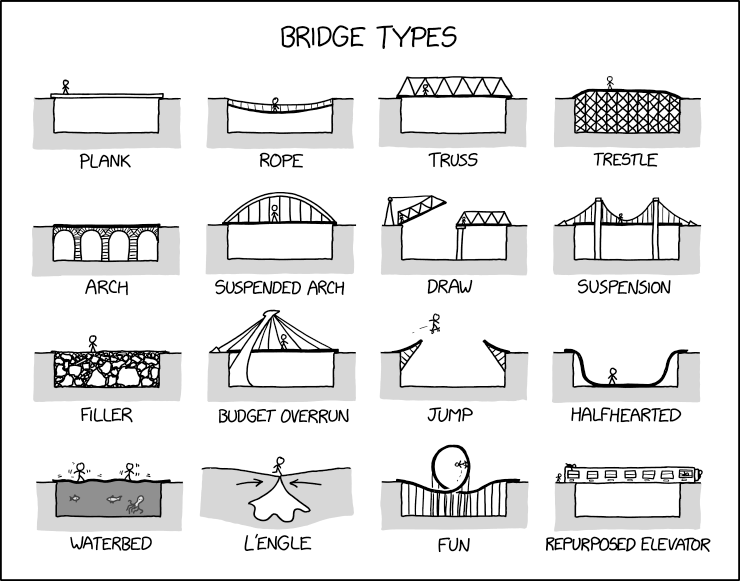 ⌘ Read more